
[Smart City Today]
The Ministry of Land, Infrastructure and Transport announced that it approved special regulatory cases for smart city demonstration projects to solve urban problems in Gyeonggi-do, Daegu, Gangneung, and Gyeongsan.
With the approval of five new empirical special projects this time, a total of 39 regulatory special cases have been approved for smart city technologies and services since the introduction of the system in February 2020.
The five new projects to be approved and announced on September 7 are as follows.
▶Hwaseong Delivery Robot in Gyeonggi-do: Hyundai Motor Co.
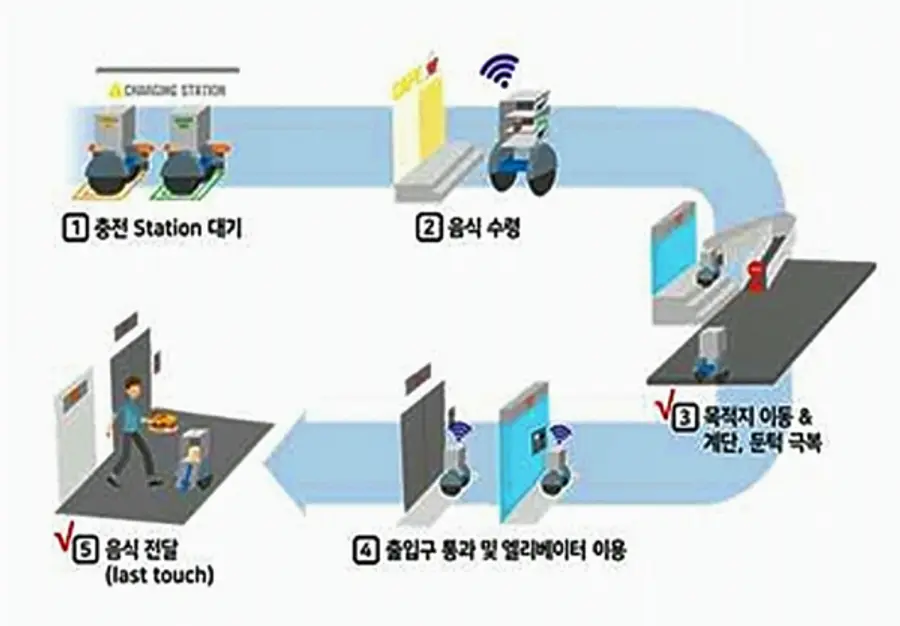
In Hwaseong, Gyeonggi-do, a new type of delivery robot will be operated to overcome the limitations of existing self-driving delivery robots.
Hyundai Motor Co. plans to demonstrate the delivery of convenience store items and pizza by developing a delivery robot that can freely climb up and down obstacles such as stairs and hills.
To improve the shortcomings of the existing delivery agency service and self-driving delivery robots, the shape of the wheels can be freely deformed to maintain equilibrium even on stairs, which can solve the inconvenience of apartment residents and contribute to the development of the industry in the autonomous robot field.
▶Daegu AI-based park safety operation system: Pintel Consortium Co., Ltd
The Park Safety Operation System with Artificial Intelligence Technology (Pintel Consortium Co., Ltd.) will be demonstrated in Daegu City.
It plans to reduce accidents and crimes in urban parks by detecting dangerous behavior of CCTV images in parks with artificial intelligence image analysis technology.
In addition, it is expected that the efficiency of park management can be improved based on data analysis such as park user density, occupied space, and usage time collected through image analysis.
▶Electric Vehicle Zone-Free Charging System in Gyeongsan, Gyeongsangbuk-do: FEC Co., Ltd
At a public parking lot in Gyeongsan, Gyeongsan-si, Gyeongsan-buk-do, the "electric vehicle zone-free charging system" FCE, Co., Ltd.
It plans to install a small number of electric vehicle chargers and establish a system that allows drivers to charge without moving on any parking surface in the electric vehicle charging area through wires and connections.
Through this, it is expected to solve the inconvenience of leaving the charged vehicle in a hurry or waiting for a long time due to a lack of charging areas.
▶ Demand-responsive mobility in seven local governments in Gangneung and Gyeonggi-do (Suwon, Goyang, Hwaseong, Ansan, Pyeongtaek, Hanam, Yangju)
Demand-response mobility, which is well received by the public due to the shorter waiting and travel times and increased convenience of public transportation, is also demonstrated in seven local governments in Gangneung and Gyeonggi Province (Suwon, Goyang, Hwaseong, Ansan, Pyeongtaek, Hanam, and Yangju).
Demand-response mobility refers to a mobility system that changes routes in real-time according to passenger demand, and when a passenger calls from the platform (App), the location and route of the passenger are analyzed with an AI algorithm to derive the optimal route.
▶Gangneung City (Ciel Co., Ltd.) demonstrates a demand-response city tour bus service that can solve problems such as traffic jams and lack of parking spaces caused by the increasing number of tourists using cars.
▶Gyeonggi-do (Hyundai Motor Co. Consortium) operates an integrated demand-response mobility service in Gyeonggi-do that allows transfer discounts in connection with existing public transportation and shared personal transportation to find a solution to traffic inconvenience in the early new city.
Meanwhile, smart city regulatory sandboxes can be applied at all times through the KAIA(Korea Agency for Infrastructure Technology Advancement) and the Korea Chamber of Commerce and Industry, and support demonstration costs within 500 million won along with regulatory exceptions.


![[토큰경제학] 엔비디아의 다음 돈줄은 GPU가 아니라 메모리다](https://cdn.www.smarttoday.co.kr/w400/q75/article-images/2026-06-10/b8779f99-0e61-4370-ab4d-d84e450ee10e.jpg)
댓글 (0)
댓글 작성
댓글을 작성하려면 로그인이 필요합니다.
로그인하기