
[Smart City Today]
A domestic research team supported by industry-academia cooperation in Gyeonggi Province has succeeded in developing AI technology that provides appropriate freight fares by utilizing 2 million big data such as day of the week, transportation time, and weather.
According to Gyeonggi Province on August 24, Jang Tae-woo, a professor of industrial management engineering at Kyonggi University, who is conducting research at the Gyeonggi-do Regional Research Center (GRRC), is developing a freight transportation brokerage upgrading service that includes these contents and preparing to provide assistance with private companies.
There has been a difference in position between the shipper who entrusts cargo transportation and the borrower who is responsible for actual transportation because the standardized freight rate has not been fixed in the domestic cargo transportation market. As there is no quantified freight policy, freight pricing is often undervalued, which leads to the loss of vehicle owners.
Kyonggi University's research team derived reasonable transportation charges considering 70 rate determinants such as weight, distance, and weather using 2 million freight rate data.
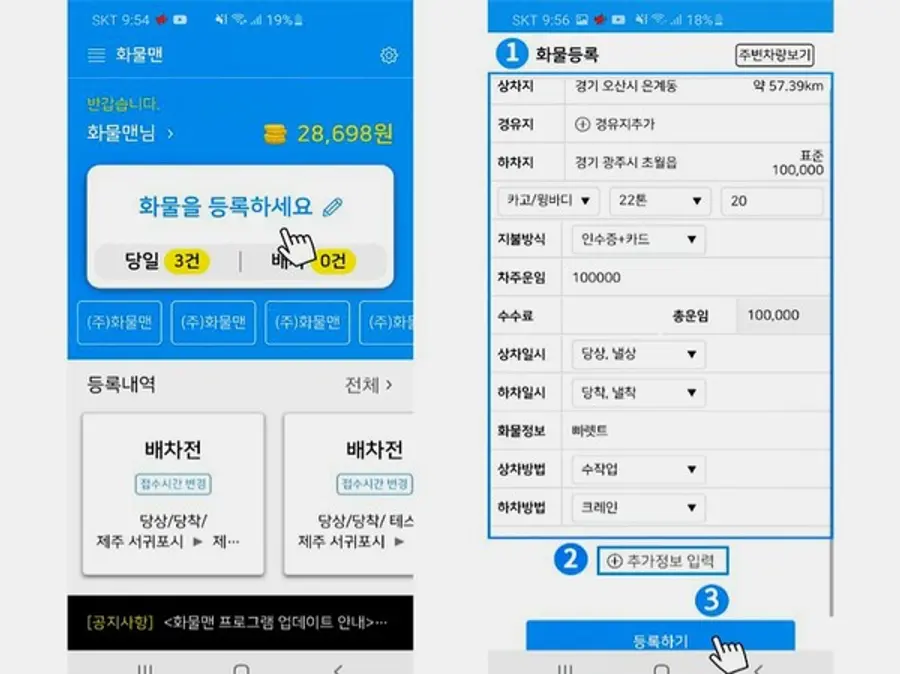
The research team's AI technology is currently being applied to Hwamul Man Ltd., a freight brokerage platform company, to develop mobile applications for standard freight transportation charge service.
The currently developing technologies that recommend cargo transportation products suitable for borrowers and technology that efficiently visualizes data analysis results. They plan to provide services from October this year as soon as the test operation is completed.
The two organizations expect that this service will provide reasonable freight rates for both shippers and borrowers, contributing to the development of the cargo industry as well as minimizing differences in position.
“This technology development is significant in that it has solved the difficulties of companies by using high-tech technologies such as artificial intelligence and big data,” said Kim Gyu-sik, a future growth policy officer in Gyeonggi Province. “We will actively support the improvement of technology competitiveness of related companies,” he said.
Meanwhile, the Gyeonggi-do Regional Research Center (GRRC) project aims to revitalize the local economy by improving the technological competitiveness of related industries as an industry-academy cooperation model that connects universities, research institutes, and small and medium-sized enterprises in the province and supports technology development activities in order to support small and medium-sized enterprises that lack research and development bases. A total of 10 centers, including Kyonggi University, are actively conducting research and development.


![[토큰경제학] 엔비디아의 다음 돈줄은 GPU가 아니라 메모리다](https://cdn.www.smarttoday.co.kr/w400/q75/article-images/2026-06-10/b8779f99-0e61-4370-ab4d-d84e450ee10e.jpg)
댓글 (0)
댓글 작성
댓글을 작성하려면 로그인이 필요합니다.
로그인하기