
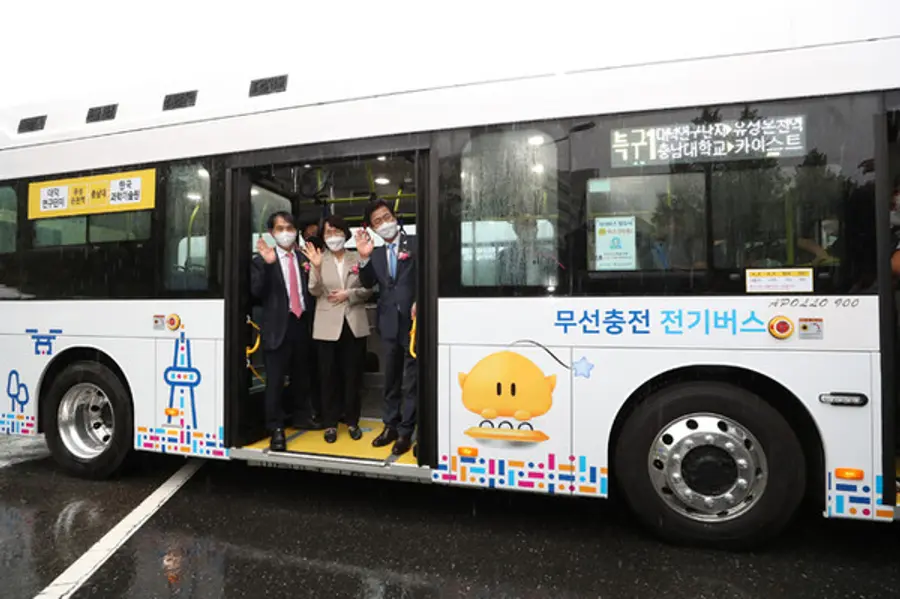
Ministry of Science and ICT (Minister Lim, Hye-sook) and Daejeon City (Mayor Huh, Tae-jeong) held a pilot operation opening ceremony of On-Line Electronic Vehicle (OLEV), a future eco-friendly bus with wireless charging technology, on August 23.
The wireless charging technology, which is applied to "OLEV", has been promoted as part of the Daedeok Science and Culture Street Project jointly supported by the Ministry of Science and ICT and Daejeon City, will also be used on regular city bus routes after two years of pilot operation to verify technical issues and civic convenience.
This wireless charging technology on 'OLEV' is a magnetic resonance technology developed by KAIST, by attaching a wireless charging device (receiver) to an electric bus, buries a wireless charging device (transmitter) at the bottom of the bus stop. It uses 85 kHz bandwidth to charge wirelessly before and after entering a bus stop and when stopping.
This method is characterized by electronic buses being able to charge even during driving and stopping by utilizing source technology (magnetic resonance formation technology) that can safely transmit large-capacity electric energy wirelessly.
In the ICT regulatory sandbox deliberation last September, the wireless charging service for electric buses was given an empirical special case to demonstrate at two bus stops in KAIST among the circular electric bus routes in Daedeok R&D Special Zone.
Unlike the wire charging method, this method, which was first applied to OLEV, not only can charge one or more without installing a separate charging facility or additional connecting parts (connector), but also has a power supply line (cable) buried in the ground, which is considered to be superior to other transportation means in terms of safety and site utilization.
The electric bus "OLEV" can charge up to 150kw in 1 hour and drive 150km per hour. However, on the Daedeok Special Zone circulating route, which started pilot driving from the 24th, the bus driver will charge 50kw for 20 minutes and run 23.5km.
Daejeon City will test-run the Daedeok Special Zone circulation route connecting KAIST to Daedeok Special Zone Yeongyeon~DCC to Urban Railway Station (Wolpyeong, Yuseong Hot Spring, and Guam) for two years. The first bus is at 6 a.m. and the last one is at 10 p.m., and the fare is 1,250 KRW (750 KRW for teenagers and 350 KRW for children), which is the same as the regular city bus fare, and only transportation cards are available.
“The demonstration of wireless charging bus technology is a bold challenge for the 2050 carbon-neutral future, and it is the beginning of the people’s experience of science and technology in real life and improvement of quality of life. We will spare no effort to provide policy support, such as investment in technology development so that we can speed up the transition to a carbon-neutral society through science and technology.” Said Minister Lim Hye-sook.
■ Overview of KAIST Development Wireless Charging Technology
- Cho Dong-ho, professor of the Korea Advanced Institute of Science and Technology developed wireless charging systems using 53 original technologies (2009 ~ 2017.5)
- Establishment of Y Power One, a company that produces wireless power transmission devices as its main items (2018.2, CEO Kim Je-woo, CTO Cho Dong-ho)
- Promoting a business agreement for the demonstration of wireless charging electric buses that the technology is applied (Daejeon City, KAIST, Special Zone Foundation/2020.6.)
- Selected as a ‘2020 technology commercialization capability strengthening project’ (Special R&D Zone Project) and carries out tasks to develop commercial technologies and commercialize them (2020.6~2021.5 / 1.7 billion won in government contributions)
- The empirical special case to "85KHz electric bus wireless charging service" 12th ICT regulatory sandbox deliberation, 2020.9.23)
■ What is wireless charging?
◆ High-efficiency transmission of large amounts of energy wirelessly by magnetic resonance by installing supply lines on roads and installing current collectors on electric buses or electric vehicles.
◆ Provides a wireless charging solution that allows batteries to be charged even during the operation of an electric vehicle, dramatically expanding the mileage pointed out as a limitation of the electric vehicle.
■ The key technology of wireless charging
The core structure is made of ferrite material with a high investment rate at the bottom of the wire to form a magnetic field only in the upward direction so that it can be charged with high efficiency without the loss of the magnetic field.
■ Benefits of wireless charging
- Increase battery efficiency and lifespan by keeping battery charge at a constant level
- Increase battery life and reduce the number of battery exchanges to secure economic feasibility
- The power supply cable is buried so there is no risk of electric shock and safety
- Wireless charging is charged through current collection pick-up, enabling the utilization of any wireless charging power supply infrastructure to achieve efficiency
- Multiple chargeable without additional charger installation or connector installation
Reported by Smart City Today


![[토큰경제학] 엔비디아의 다음 돈줄은 GPU가 아니라 메모리다](https://cdn.www.smarttoday.co.kr/w400/q75/article-images/2026-06-10/b8779f99-0e61-4370-ab4d-d84e450ee10e.jpg)
댓글 (0)
댓글 작성
댓글을 작성하려면 로그인이 필요합니다.
로그인하기