
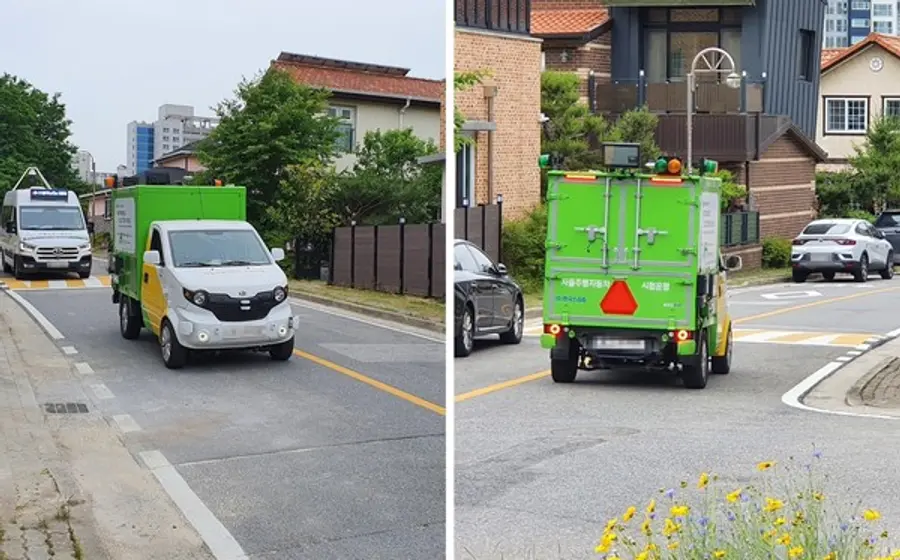
For the first time in Korea, an unmanned self-driving car will be demonstrated on side roads such as alleyways in residential areas in Gwangju City.
The vehicle will collect domestic waste from the housing complex, move to the next spots by unmanned autonomous driving technology after the driver picks up the waste.
The site for demonstration is Seongdeok Country Village in Suwan District, Gwangsan-gu, Gwangju.
This vehicle will drive at a very low speed of less than 5km/h along a predetermined route to ensure safety.
Also, IoT infrastructure sensors have been installed in the area to secure visibility in blind spots in preparation for possible accidents, letting the vehicle be able to deal with emergencies.
In the demonstration area, the vehicle will collect garbage in an unmanned autonomous driving mode through a button attached to the outside of the vehicle.
The collection will be repeated until the designated task is completed, and by monitoring from the autonomous driving control center and on-spot security personnel, it can respond quickly and accurately to dangerous or any problematic situations.
The unmanned waste collecting vehicle for the demonstration project is an autonomous electric vehicle jointly developed by IMR Inc., Threechuk Korea, and K.Ace Lab, and is a strategic vehicle based on an open variation platform for electric vehicles.
The autonomous driving system on this vehicle is equipped with a vision sensor-based semantic autonomous driving system developed by K.Ace Lab, instead of the expensive LiDAR sensor-based autonomous driving system, built with future commercialization in mind.
This project is being carried out to make a breakthrough in the automobile industry in Gwangju, to foster the high value-added unmanned vehicle industry, to solve the manpower shortage caused by an aging population, and to improve the working environment for workers.
Through this project, Gwangju expects to overcome the crisis of the future automobile industry of the city and lay the foundation for the commercialization of autonomous driving by establishing a high value-added intelligent vehicle industrial ecosystem.
In addition, it seems that the local economy will be revitalized by linking autonomous driving with the automobile factory in Gwangju and providing public service for citizens’ convenience as well as high-quality jobs by the development of unmanned special vehicle services.
“We will strive to promote the commercialization of autonomous vehicles and improve the autonomous vehicle-related legal system through the demonstration project,” said Kim Kyung-soo, the CEO of IMR Inc. which is in charge of the project.
“As the residential waste collecting vehicle operates in narrow alleyways, it can be a good alternative in case of simultaneous administrative demands such as snow removal due to heavy snowfall and a sprinkler vehicle due to a heatwave, so there is a high possibility of commercialization,” said Park Jun-yeol, the head of the automobile industry in Gwangju City. “We plan to give a business briefing for local governments nationwide based on empirical data.”
Reported by 'Smart City Today'


![[토큰경제학] 엔비디아의 다음 돈줄은 GPU가 아니라 메모리다](https://cdn.www.smarttoday.co.kr/w400/q75/article-images/2026-06-10/b8779f99-0e61-4370-ab4d-d84e450ee10e.jpg)
댓글 (0)
댓글 작성
댓글을 작성하려면 로그인이 필요합니다.
로그인하기