
Researchers in Korea have developed the world's first carbon nanotube fiber that can store energy while being stronger than metals.
This is noteworthy because it opened the way for electric vehicles that can charge and run the vehicle body instead of installing batteries.
Dr. Kim Tae-hoon's team at the Korea Institute of Materials (KIMS) announced on January 10 that it has developed the world's first high-strength fiber-type supercapacitor with high energy storage and high-strength properties using carbon nanotube fibers.
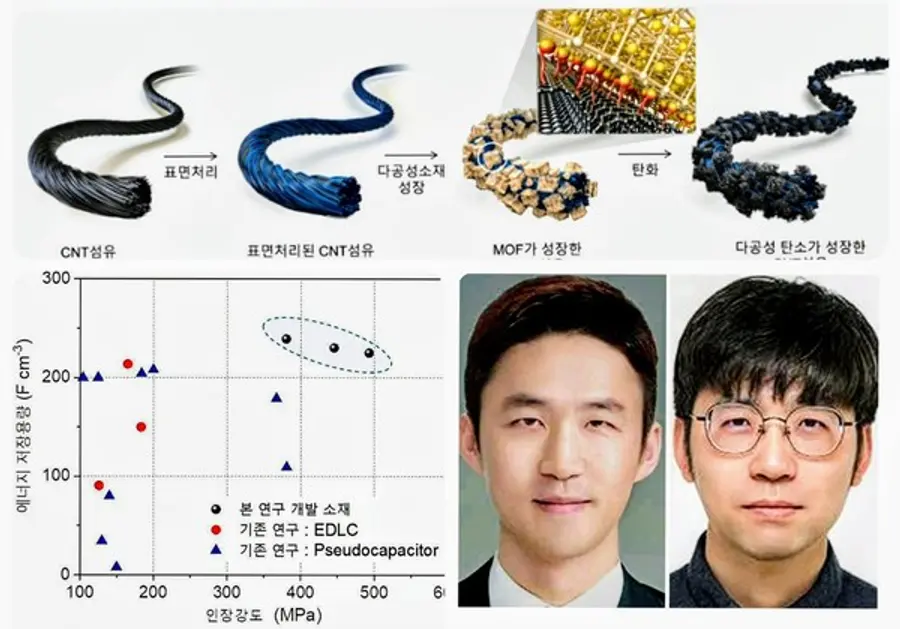
Currently, the energy storage and structural materials are characterized by having only one characteristic of high strength or high energy storage function, but the materials developed by this research team are light, strong, and have two characteristics at the same time using carbon nanotube fibers with excellent electrical conductivity.
After surface treatment on carbon nanotube fibers, the research team grew porous carbon to manufacture a high-strength fiber-type supercapacitor. Through this, it was possible to synthesize a new fibrous material that was given energy storage characteristics while maintaining the strength of the carbon nanotube fibers.
The research team confirmed that the developed fibrous supercapacitor is operating normally while supporting heavyweight.
Although existing technology should have a material supporting battery and body weight separately, the material developed this time can replace both materials, which is meaningful in that it suggests a new direction for the development of lightweight materials in the future. Especially, multifunctional carbon nanotube fiber technology is expected to be used in electric vehicles, drones, and space and aviation fields that require lightweight, the research team said.
"If multifunctional carbon nanotube fibers are used, it will help improve the mileage of future mobility such as drones," said Kim Tae-hoon, senior researcher at the research center. "It is expected to be applied not only to energy storage materials but also to space, aviation, and defense fields that require lightweight, high strength, and high conduction."
The results of this research were supported by the Ministry of Science and ICT and received support from the Korea Institute of Materials and Materials for the development of textile materials technology for the fusion of energy production and storage materials and the 4U complex material development project of the Korea Institute of Science and Technology. The results of the study were published in the January 5 issue of Science Advances, a sister magazine of Science, well known as a world-renowned journal.
Reported by Smart City Today


![[토큰경제학] 엔비디아의 다음 돈줄은 GPU가 아니라 메모리다](https://cdn.www.smarttoday.co.kr/w400/q75/article-images/2026-06-10/b8779f99-0e61-4370-ab4d-d84e450ee10e.jpg)
댓글 (0)
댓글 작성
댓글을 작성하려면 로그인이 필요합니다.
로그인하기