
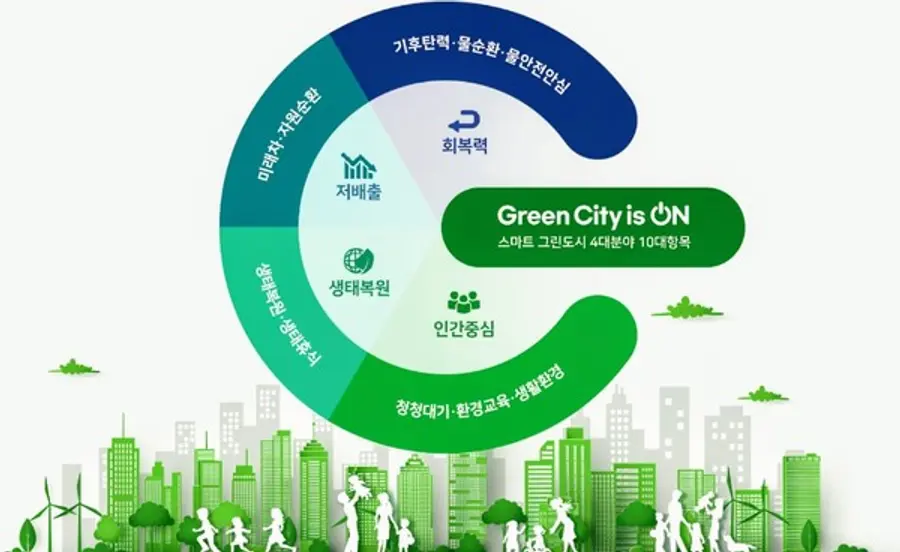
Starting in the new year, the smart city promoted by each local government has to be "green".
The Ministry of Land, Infrastructure and Transport announced that it will revise and implement the Urban and Gun Basic Plan Establishment Guidelines and Urban Development Guidelines from December 30 to reflect carbon neutralization plan elements.
The main contents of this amendment to the Guidelines for Establishing Basic Urban and Gun Plans are as follows.
1. Presentation of the principle of establishing a basic urban group plan for transition to a carbon-neutral society
The purpose and direction of transition to a carbon-neutral society proposed in the Framework Act on Carbon Neutral and Green Growth for Responding to Climate Crisis were reflected in the general rules of urban and county basic plans and sectoral planning principles.
2. Basic survey on the status of greenhouse gases and setting goals for reducing greenhouse gases by city
When establishing a basic plan for cities and counties, the current status of greenhouse gas emissions and absorption was added to the basic survey to understand the characteristics and status of the region, and based on this, greenhouse gas reduction goals were presented every five years until the target year of the basic plan.
3. Mandatory reflection of carbon-neutral planning elements in sectoral plans such as spatial structure, transportation system, and park green area
Carbon neutrality planning elements were reflected in plans for each sector, such as spatial structure, transportation system, residential environment, and parks and green areas, which constitute basic urban and county plans.
■The main contents of the carbon neutrality plan for each category.
▸Spatial structure.
A map of urban status related to carbon neutrality, such as a greenhouse gas status map, a building energy demand map, and a distribution of absorption sources, was established and applied to the reorganization of the spatial structure.
▸Transport system
Expanding eco-friendly transportation such as bicycles and electric vehicles, and planning a green logistics system, etc.
▸Residential environment
Expansion of green buildings such as green remodeling and expansion of carbon absorption sources in houses such as planting.
▸Energy and waste
Measures to reduce fossil fuel use, expand the use of new and renewable energy, induce resource circulation, etc.
▸Park and green area
Expansion of carbon absorption sources and mitigation of heat island phenomena such as the creation of urban wind roads.
Establishment of a plan to create a carbon-neutral city for each local government
According to the basic plan of cities and counties, a plan to create a carbon-neutral city was established to achieve the annual greenhouse gas reduction goal.
Accordingly, local governments will propose greenhouse gas reduction measures and establish plans to achieve reduction goals by summing the estimated reduction amounts for each reduction method.
Meanwhile, the main contents of the amendment to the 'Urban Development Business Guidelines' are as follows.
When conducting a basic survey to promote the supply and utilization of new and renewable energy, the current status of new and renewable energy facilities such as hydrogen in areas adjacent to urban development zones was included in the survey.
3. Expanding the introduction of green buildings and green transportation
In order to minimize the energy consumption of buildings, green architecture and green transportation planning standards have been improved to include zero-energy complexes and hydrogen-electric vehicle charging facilities in the review list when establishing development plans.
4. Reinforcement of integrated operation and management at the urban level, such as energy use and carbon reduction
In order to strengthen integrated operation management for energy use and carbon reduction, the establishment of an integrated urban operation center or connection with an existing center has to be reviewed at the development planning stage.
An official from the Ministry of Land, Infrastructure and Transport said, "The revision of the guidelines has laid the groundwork for realizing carbon neutrality at the regional and urban level," adding, "We will continue to make policy efforts to accelerate the achievement of carbon neutrality across the country."
Reported by Smart City Today


![[토큰경제학] 엔비디아의 다음 돈줄은 GPU가 아니라 메모리다](https://cdn.www.smarttoday.co.kr/w400/q75/article-images/2026-06-10/b8779f99-0e61-4370-ab4d-d84e450ee10e.jpg)
댓글 (0)
댓글 작성
댓글을 작성하려면 로그인이 필요합니다.
로그인하기