
Six kinds of smart care services will be provided 24 hours a day for the elderly and the disabled by utilizing advanced technologies such as artificial intelligence (AI) and the Internet of Things (IoT).
The Ministry of Land, Infrastructure and Transport and the Korea Land and Housing Corporation announced that they will launch a pilot project for smart care tailored to the elderly at Ssangchon Permanent Rental Housing in Gwangju.
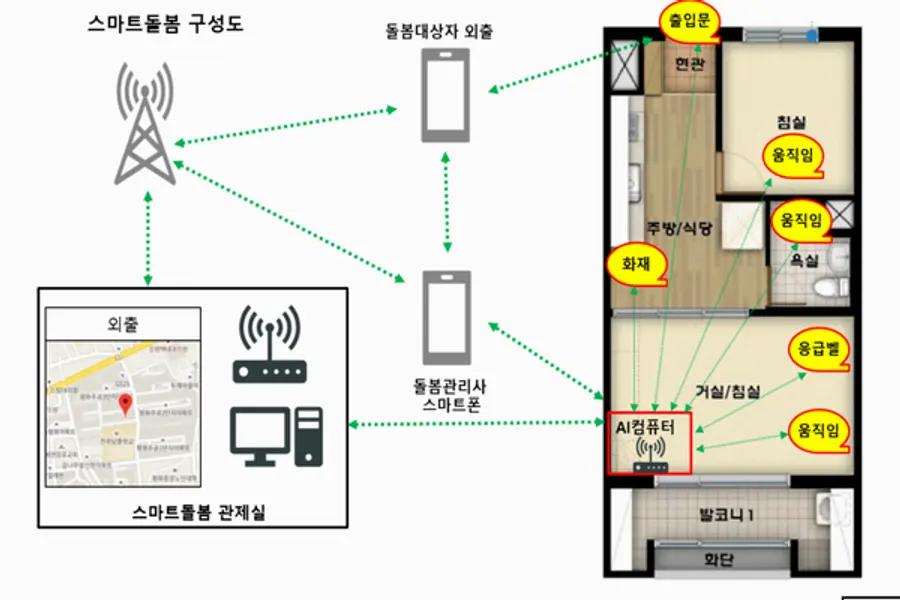
The pilot project will provide six services: △ 24-hour emergency control, △ emergency bell response, △ location check when going out, △ interactive communication, △ personalized health care, and △ daily life pattern prediction and management.
Through such smart care services, it is expected that it will be possible to respond quickly to emergencies, and further respond to crisis situations by analyzing individual life pattern data including daily activities, health, and sleep.
For this project, the government has provided general support for permanent rental housing facilities, LH supported the budget for installing smart care platforms, Gwangju Seo-gu Office has been in charge of operating care services, and Welfare Village developed and installed smart care devices.
The Ministry of Land, Infrastructure and Transport and LH selected the target site through a public contest of elderly welfare housing complex, completed the supply of 2,260 units as of 2021, and plans to supply 10,000 units by 2025.
A total of 80% of the construction cost of public rental housing among the elderly welfare housing complex is provided by the government, and barrier-free design such as door sill removal and safety handle installation will be able to let senior citizens live a safe and comfortable life.
In addition, the Ministry of Land, Infrastructure and Transport provides 27.3 billion won in construction costs per site and builds welfare centers and health centers equipped with health and leisure facilities to be used as welfare bases for the elderly in the region.
In fact, Senior Welfare House in Yeongcheon, Jangsung, which has been operating since 2019, has been supplied with rental housing for 150 elderly people and 1,080㎡ welfare facilities, providing elderly housing, welfare, and health services by expanding services to not only the residents but also all local seniors. About 200 people use welfare programs such as path restaurants, cognitive improvement programs, and gardening classes on a daily basis.
Meanwhile, the Elderly Welfare House in Eungye, Siheung, which has a combination of social welfare facilities of 190 rental housing and 1,700㎡, provides the visit service for vulnerable elderly households such as mobility inconvenience and mild dementia and carries out no-no-care (老老CARE) projects to share hobbies, reducing the burden of families, providing convenience for seniors and increasing opportunities for social participation.
“The smart care pilot project is very significant at this time when 90% of all permanent rental housing getting old more than 15 years,” said Kim Hong-mok, a housing welfare policy officer at the Ministry of Land, Infrastructure and Transport. “We will closely examine the future performance and expand it to new elderly welfare housing with LH and local governments across the country and rental housing for vulnerable people who need 24 hours of help.”
Reported by Smart City Today


![[토큰경제학] 엔비디아의 다음 돈줄은 GPU가 아니라 메모리다](https://cdn.www.smarttoday.co.kr/w400/q85/article-images/2026-06-10/b8779f99-0e61-4370-ab4d-d84e450ee10e.jpg)


댓글 (0)
댓글 작성
댓글을 작성하려면 로그인이 필요합니다.
로그인하기