
The Ministry of Land, Infrastructure and Transport announced that it has finalized the "Basic Plan for the Establishment of the Third Transit Center and the Complex Transit Center" (hereinafter referred to as the "Basic Plan for Transit Center") to establish a fast and convenient transfer system at major transportation hubs nationwide over the next five years
The transfer center basic plan is the highest legal plan for the transfer center established in accordance with the National Transportation System Efficiency Act.
The Ministry of Land, Infrastructure and Transport, together with the Korea Transport Research Institute, prepared a plan through sufficient opinions from local governments, related organizations and experts, and confirmed the basic plan of the third transfer center through deliberation by the National Transportation Commission.
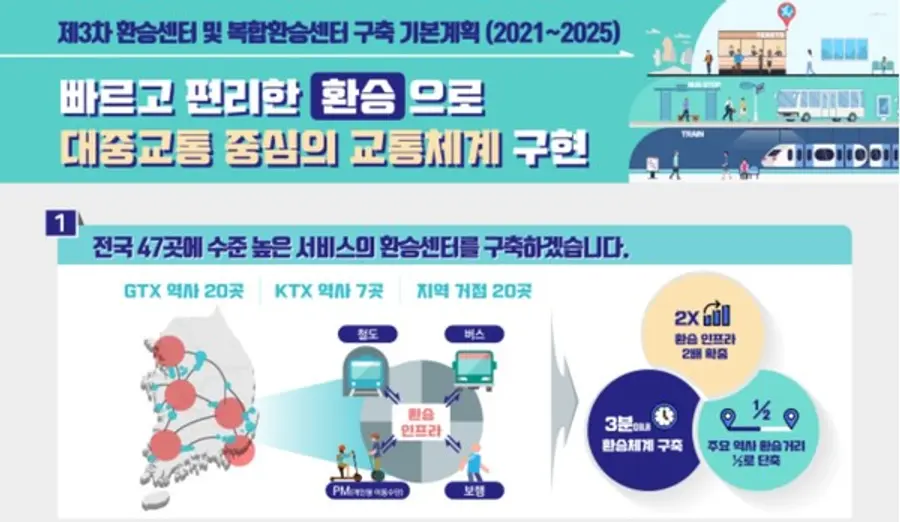
The third transfer center basic plan sets up a future vision of 'implementing a transportation system centered on public transportation with quick and convenient transfer', and contains institutional innovation, future response plan, and transfer center construction plan to achieve this.
The Ministry of Land, Infrastructure and Transport predicted that by 2025, when the plan is completed, the transfer infrastructure will more than double comparing the current status, allowing transfer within three minutes, and the transfer distance of major station will be shortened to 1/2. The specific contents are as follows.
■ Smart Transfer Implementation
▷Implementation of Low Carbon and Green Transfer Facilities
The Ministry of Land, Infrastructure and Transport has decided to strengthen the mobility hub function of transit facilities in response to the revitalization of green mobility, such as the spread of eco-friendly cars and the expansion of the personal mobility market.
The standard model of transfer facilities linking hydrogen, electric charging stations and shared mobility will be developed by 2022, and from 2023, the project will be carried out through the cooperation of ministries to pilot eco-friendly transfer facilities.
▷ Implementation of Future Smart Transfer System
In addition, the Ministry of Land, Infrastructure and Transport plans to develop a customized transfer model in response to the development of future transportation and to preemptively improve the system in preparation for the commercialization of new transportation such as autonomous driving vehicles and urban air transportation (UAM).
First, it will use the latest technologies such as digital twin and big data to analyze the traffic and transfer prediction of new transportation methods and develop customized transfer models based on this.
Moreover, considering the level of technology development of autonomous vehicles and UAMs, it plans to present necessary facilities (such as getting in and out of the landing area, landing area, etc.), facility size, and placement standards for future transfer conditions by 2025.
■ System Innovation to Establish Optimal Transfer System
▷Establishing a foundation for proactive transfer planning
First, major transportation facilities such as railways will introduce a "transfer system pre-review system (*tentative name)" from next year so that linked transfer systems will be reviewed from the initial planning stage.
Until now, there have been many cases where a transfer is inconvenient and unnecessary post-facility improvement costs are incurred due to lack of connectivity between transportation such as the construction of late transfer facilities after the completion of the railway station.
The introduction of the transfer system pre-review system is expected to increase the convenience of transit facilities and enable the public to conveniently transfer, which will also boost public transportation use.
The transfer center promotion procedure will be improved to support local governments and operators to systematically and promptly implement the project as well.
▷Introduction of the general planning team system
The comprehensive planning team system, which is currently piloting nine projects including Yangjae Station, Suwon Station, Yongin Station, Deokjeong Station, Incheon City Hall Station, Bupyeong Station, Songdo Station, Mangwoo Station, and KINTEX Station, will be activated from 2022 to build a local landmark.
The General Planning Team is a system in which private experts from various fields such as transportation, city, and architecture participate and establish business plans through various and three-dimensional reviews.
Through this, high-quality transfer centers such as Salesforce Transit Center in the United States and Arau Bus Station in Switzerland will be built in Korea, and the space platform function will be performed as well as the role of transportation hub connecting the inside and outside of the city.
▷Operation of Transfer Governance Council
The transfer facilities have been difficult to adjust their interests so far because there are many related institutions as various transportation methods are located in organically linked spaces.
In order to solve these difficulties, the Transit Governance Council, which includes the Metropolitan Transport Commission, related organizations (local governments, construction companies, private businesses, etc.), and private experts, will be institutionalized by the second half of 2021.
■Establishment of a transfer center with high-quality services
Based on this system, the government plans to build a new transfer center and a complex transfer center with a sense of speed.
In line with the opening of GTX, it will establish a transfer center in 20 major GTX stations, and build transfer centers in 7 KTX station and 20 base areas where large-scale transfer demand occur.
In particular, the railway station will reduce the transfer distance between railway and bus to 180m and less than 3 minutes of transfer time through the underground arrangement of bus stops, moving walks, and high-speed elevator installation, and strengthen linkage with shared mobility, taxis, and passenger cars.
“We will push forward the construction of transfer infrastructure and detailed tasks without any hitches, focusing on minimizing the inconvenience of people’s transit, such as creating pleasant commute conditions by implementing a smart transfer system and improving the mobility of the transportation-impaired,” said Baek, Seung-keun, chairman of the Metropolitan Transportation Commission of the Ministry of Land, Infrastructure and Transport.
Reported by Smart City Today


![[토큰경제학] 엔비디아의 다음 돈줄은 GPU가 아니라 메모리다](https://cdn.www.smarttoday.co.kr/w400/q75/article-images/2026-06-10/b8779f99-0e61-4370-ab4d-d84e450ee10e.jpg)
댓글 (0)
댓글 작성
댓글을 작성하려면 로그인이 필요합니다.
로그인하기