
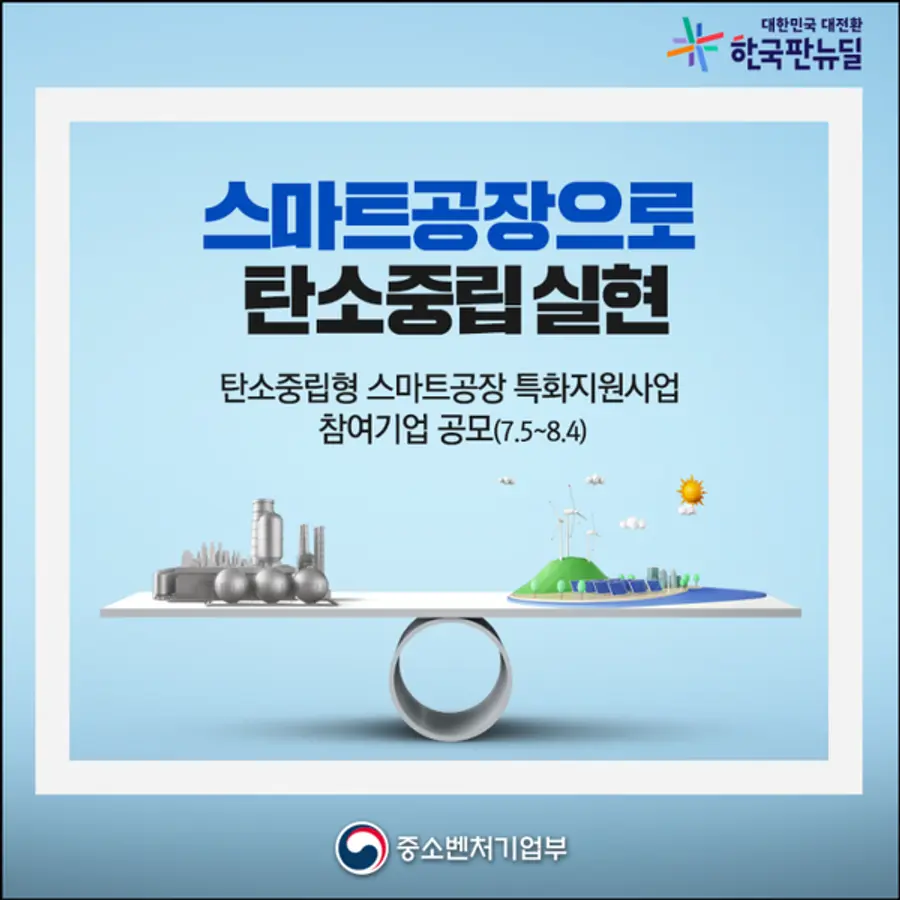
The Ministry of SMEs and Startups announced a “carbon-neutral smart factory” support project for small and medium-sized enterprises that are burdened with costs related to process improvement and facility introduction as the biggest obstacle to low carbon transition. It said it will recruit small and medium-sized enterprises by August 4.
The Ministry of SMEs and Startups will promote a specialized smart factory support project which is effective in reducing carbon in order to occupy the global carbon-neutral initiative and strengthen support for field-oriented smart manufacturing innovation that reflects global trends.
The amount of support will reach a total of KRW 3 billion per company, including 70 million won (basic) and 200 million won (advancement), depending on the target level of smartening of carbon-neutral smart factories.
In particular, for facility investment which requires large-scale funds, such as high-efficiency facilities, additional support can be provided up to 10 billion won per company through a loan method in connection with the policy fund from the Small and Medium Business Corporation.
The Ministry of SMEs and Startups has decided to provide specialized support for carbon-neutral smart factories through one-stop with three major packages: ❶ energy diagnosis and design consulting, ❷ ICT-based carbon reduction process innovation, and ❸ high-efficiency facility facilities.
Support details are as follows.
❶ (Diagnosis and Design Consulting) Private energy management institutions identify the actual state of energy use and loss factors in the field, and present improvement methods to improve energy efficiency based on smart factories.
❷ (Carbon Reduction Process Innovation) It will fully support building a carbon-neutral smart factory, including controllers, measurement infrastructure, and automation facilities linked to manufacturing data-based energy management and process innovation solutions (FEMS, MES, etc.)
❸ (High-efficiency facilities) It will support the replacement of high-efficiency facilities that are effective for energy reduction, focusing on energy-consuming and old utility facilities.
In order to strengthen strategic support, the support sections were limited to six industries including roots (welding, casting, plastic working, heat treatment), textiles, and automobiles. In particular, effective tasks in carbon neutrality are designated in advance within the relevant industries.
Designated tasks were selected in consideration of the industrial ecosystem aspects such as ▲ carbon reduction effect, ▲ demand for process innovation in the field, and ▲ scalability of the same type and similar business type in consideration of industrial ecosystem.
Meanwhile, the Ministry of SMEs and Startups is focusing on the supply of 30,000 smart factories by 2022 and has contributed to the innovation for smart production systems of SMEs by supplying about 20,000 plants by the end of last year.
The benefited companies have shown process improvements such as productivity improvement by 28.5% and cost reduction by 15.5% on average, which leads to a 7.4% increase in sales and other business performance.
“We plan to actively foster a carbon-neutral smart factory as one of the pillars of building a sustainable economic system along with process and management improvement outcomes. We will expand our support,” said Il-ho Kim, head of the Smart Manufacturing Innovation Planning Team at the Ministry of SMEs and Startups.
More details can be found at a business notice of the Small and Medium Venture Business Promotion Agency (www.kosmes.or.kr), a specialized operating organization, and applications can be made online at the Smart Factory Business Management System (www.smart-factory.kr).
Reported by 'Smart City Today'


![[토큰경제학] 엔비디아의 다음 돈줄은 GPU가 아니라 메모리다](https://cdn.www.smarttoday.co.kr/w400/q75/article-images/2026-06-10/b8779f99-0e61-4370-ab4d-d84e450ee10e.jpg)
댓글 (0)
댓글 작성
댓글을 작성하려면 로그인이 필요합니다.
로그인하기