
Baemin, the food delivery service of Woowa Brothers, has launched the world's first service to deliver food from restaurants directly to the front door of each household of apartments by a robot.
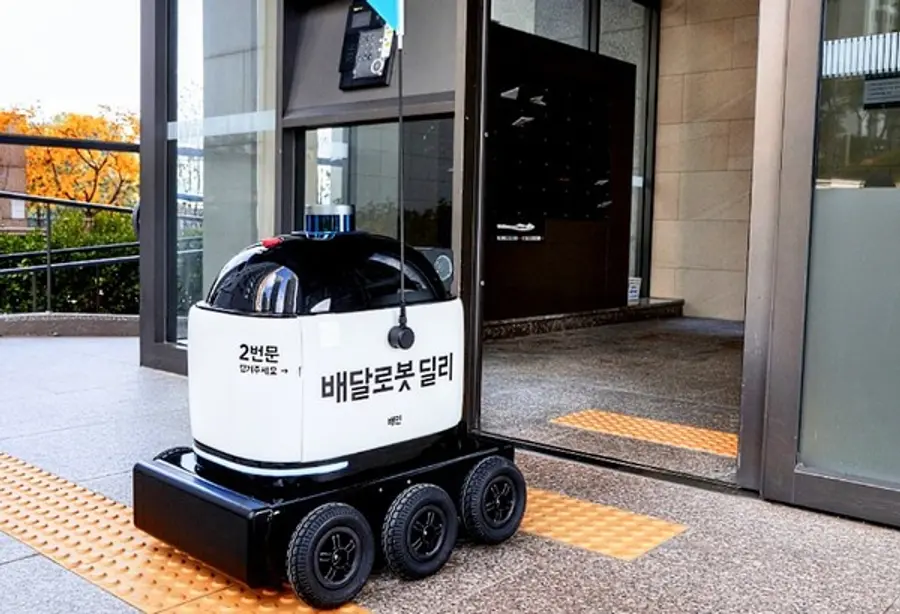
Baemin's self-driving delivery robot "Deli Drive" travels indoors and outdoors in the apartment complex and deliver food to the front door without any human help.
Woowa Brothers (CEO Kim Bum-joon), which runs Baemin, announced on December 15 that it has launched a Door to Door robot delivery service using self-driving robot Deli Drive at Gwanggyo Alliway, a residential and commercial complex in Gwanggyo, Gyeonggi-do.
Baemin's D2D robot delivery service is an upgraded version of the outdoor delivery robot service that has been in operation at Gwanggyo Alleyway for more than a year since August last year. Previously, Deli Drive received food from restaurants and delivered only to the first floor of the apartment, and the customer had to come down and receive the food.
Baemin advanced autonomous driving technology so that Deli Drive can travel freely indoors and outdoors, giving QR codes to 1,000 households in apartments, allowing delivery robots to recognize the location of each generation. After receiving the delivery, the robot recognizes the location of the generation and the number of households, moves along the pre-entered route, and performs delivery.
Baemin solved the problem of linking joint entrances and elevators, which had hampered the commercialization of robot delivery services, by applying IoT technology. When robot enters the entrance of the apartment building, the robot can freely enter and exit the common entrance on the first floor in conjunction with HDC Labs' home IoT server, and when the robot enters the apartment, the robot can call the elevator in conjunction with Hyundai Elevator's elevator control system and move to the ordering generation.
The D2D robot delivery service is carried out through a total of eight stages, including △ order reception △ movement in the complex △ movement through the joint entrance △ movement to the elevator △ delivery completion notification when the orderer scans the QR code provided in the generation and completes the order.
When an order is received from the waiting room in the complex, the Deli Drive moves itself to the restaurant. The restaurant owner only needs to put the food in the Deli Drive and press the start button. The robot travels across the apartment complex to the orderer's apartment building in an optimal path. When it arrives on the first floor of the building, it passes through the common entrance and calls the elevator to move to the ordering household floor. Orderers can receive food on the Deli Drive that arrives at the front door through phone calls and notification messages.
Baemin said it took an average of 20 minutes to complete the delivery after completing the order as a result of testing about 200 delivery situations for about a month from the beginning of last month, and there were no safety accidents such as collisions with pedestrians.
Baemin plans to expand the robot delivery service, which is currently only available within the Gwanggyo Alley Way complex, to nearby Gwanggyo Lake Park. Under the current law, delivery robots cannot operate not only on roads, but also on sidewalks, crosswalks, and parks, but Baemin is available after being approved by the Ministry of Science and ICT in September last year.
“The robot delivery service can be used for early-distance delivery or residential complex delivery, which is not well distributed due to the avoidance of delivery sources, and we expect to create new order demand for small business owners,” said Kim Yo-seop, director of robot business at elegant brothers. “In addition to Gwanggyo Alleyway complex, we will continue to develop technology and improve service quality so that D2D robot delivery services can be applied in more apartments and office complexes,” he said.
Reported by Smart City Today


![[토큰경제학] 엔비디아의 다음 돈줄은 GPU가 아니라 메모리다](https://cdn.www.smarttoday.co.kr/w400/q75/article-images/2026-06-10/b8779f99-0e61-4370-ab4d-d84e450ee10e.jpg)
댓글 (0)
댓글 작성
댓글을 작성하려면 로그인이 필요합니다.
로그인하기