
Gwangju Metropolitan City signed a business agreement with 12 organizations, including Dong-gu Office, Gwangju Urban Corporation, and Hanwha System Consortium, on April 27 to successfully promote the smart city creation project in Gwangju.
The "Regional Base Smart City Creation Project" is a public offering project by the Ministry of Land, Infrastructure and Transport, started in December last year, to create an integrated smart city for fundamental changes in the city by local governments and private companies.
As the agreement between Gwangju City and the Ministry of Land, Infrastructure and Transport was completed on March 30, this new agreement is meaningful in determining mutual cooperation and project support measures to facilitate the project.
The main contents of the agreement are ▲ mutual cooperation and project support plan ▲ data hub for urban operation efficiency, nine services, and infrastructure in four areas; energy, transportation, safety, and environment ▲ achievement and spread of project performance goals ▲ continuous cooperation after completion.
Under the agreement, Gwangju City, Dong-gu Office, and Gwangju Metropolitan City Corporation will provide 24 billion won in the budget, including 12 billion won in state funds and 12 billion won in municipal funds, and Hanwha System Consortium will invest 4.3 billion won in kind to build a high-quality smart city model based on win-win cooperation.
The main contents of this project include ▲RE100 mega station construction ▲ introduction of smart parking service in public parking lots ▲ installation of safety facilities such as artificial intelligence (AI) CCTVs, smart poles, and smart crosswalks ▲ establishment of recycling vending machines ▲ data hub in connection with CCTV control center.
First of all, the RE100 Mega station, an electric vehicle (EV) charging station that directly produces, shares, and consumes solar energy, will be built on public sites to solve the problem of the lack of electric vehicle (EV) charging infrastructure and provide eco-friendly charging services.
In addition, smart parking services will be introduced in public parking lots to solve traffic problems such as serious parking inconvenience and illegal parking in the old downtown area of Dong-gu, and AI CCTVs and smart poles will be expanded in crime areas to secure citizens' safety and prevent daily accidents. Smart crosswalks will be installed in the elderly protection zone to protect citizens from danger as well.
Moreover, in order to solve the problem of recycling garbage that has become serious since COVID-19, a recycling material collection vending machine that classifies PET, CAN, and paper with AI will be built to create a pleasant urban environment.
Besides, a data hub linked to the CCTV control center will be established to collect and analyze data from various cities necessary for policy-making by administrative agencies to lay the foundation for smart city operation.
Based on these project plans, the implementation design and plan will be established by September, and the project will be carried out with the aim of starting construction in October after approval by the Ministry of Land, Infrastructure and Transport.
Acting Mayor of Gwangju City Moon Young-hoon said, "We expect this project to be a key project to create Green Smart Fun City Gwangju, which opens a bigger and stronger Gwangju era. Through the agreement, we will support the establishment of a smart city model with completion of the public-private win-win cooperation."
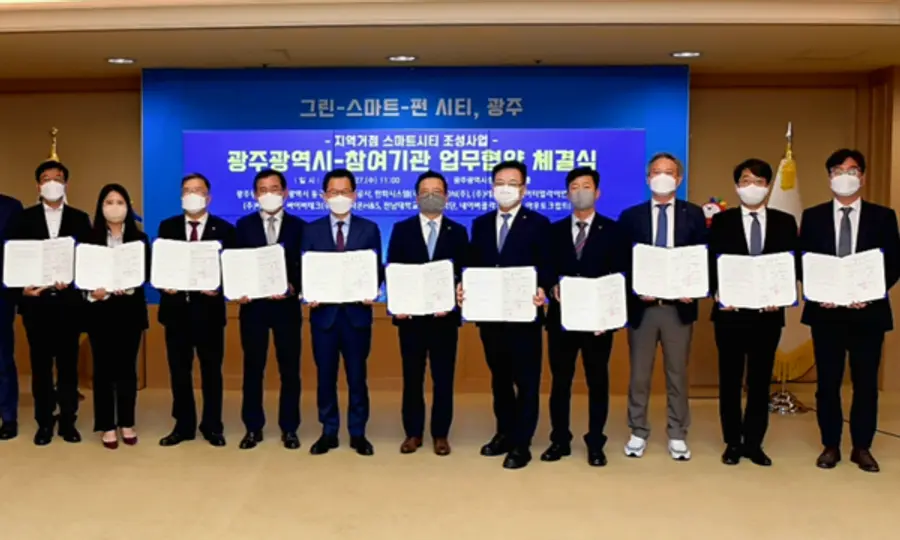
Reported by Smart City Today


![[토큰경제학] 엔비디아의 다음 돈줄은 GPU가 아니라 메모리다](https://cdn.www.smarttoday.co.kr/w400/q75/article-images/2026-06-10/b8779f99-0e61-4370-ab4d-d84e450ee10e.jpg)
댓글 (0)
댓글 작성
댓글을 작성하려면 로그인이 필요합니다.
로그인하기