
The National Agency for Administrative City Construction (NAACC, Director Park Moo-ik) plans to expand the smart city construction project, which was being piloted in some living areas, to the entire administrative cities.
To this end, the NAACC plans to designate a private project implementer and finalize the smart base construction project.
On March 30, the NAACC announced the "2022 Administrative City Major Business Promotion Plan" with these contents as its main focus.
This year, the NAACC will make the best efforts to complete the city by 2030, reflecting the newly introduced urban functions in the city plan, further improving settlement conditions, and continuing to promote urban growth and regional win-win cooperation projects.
First of all, the agency decided to inspect and newly establish the city plan in order to support various functions additionally introduced in the administrative cities, such as the construction of the National Assembly building in Sejong.
The administrative city is being constructed based on the basic construction development plan, which is the basis for urban construction, such as urban function, spatial structure, and transportation.
Through this year, it plans to push for a full reorganization of the basic construction plan and development plan for the administrative city, which was first established in 2006 so that various changes in conditions such as urban construction achievements and additional legislative functions can be sufficiently reflected in city plans.
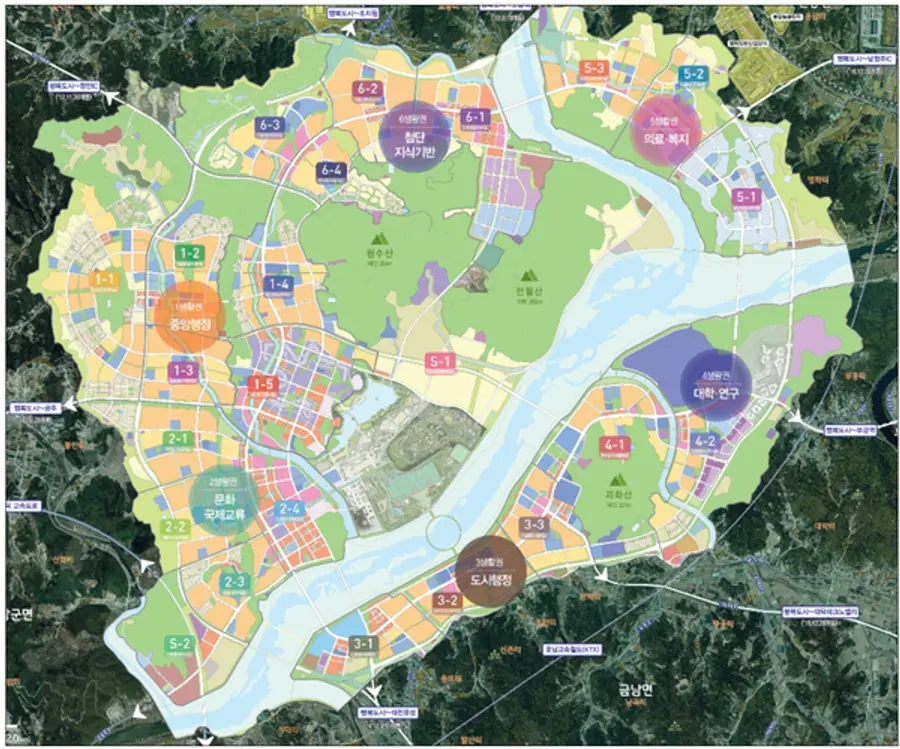
In addition, the S-1 living area and 6-1 living area district unit plan near the location of the National Assembly building in Sejong will be established early this year, one year earlier than the original plan, so that the legislative function can be successfully settled in the city.
Second, in order to create a more livable city, it was decided to stabilize housing and supply specialized houses on various topics.
It plans to continue to supply housing for real users, such by completing about 4,000 apartments and starting construction of 7,000 apartments, and coming up with housing measures for new youth institution workers, such as supplying rental housing for public officials.
In addition, a specialized plan will be established to create a smart, walking, community-themed apartment and Hanok, zero energy, urban agricultural-themed detached house specialized village centering on the 5-1 living area and the 5-2 living area.
Third, for urban revitalization and balanced national development, it will start the creation of an Administrative City-type joint campus and continue to attract functions in the Seoul metropolitan area.
The joint campus is a new concept of the university where a number of universities and research institutes jointly move in and use various facilities together and is being built in the 4-2 living area of the administrative city with the aim of opening in 2024.
Also, the construction of rental campuses among joint campuses such as Seoul National University, Chungnam National University, Chungbuk National University, Hanbat University, KDI Graduate School of International Policy (rental type), Gongju University, and Chungnam National University (ideal type), which were confirmed to move in last year, will begin, and a second recruitment announcement will be made for four pre-sale campuses that have not yet been supplied.
Moreover, in order to create a high-tech industrial ecosystem that leads the fourth industry, it will promote the eighth supply of Sejong Tech Valley, located in the 4-2 living area, after conducting promotional activities centered on companies in the Seoul metropolitan area.
Fourth, it plans to promote the smart city national pilot city project in earnest and continue to build a smart base for the administrative city.
It will specifically create a smart city, the national demonstration city located in the 5-1 living area, such as designating private project implementers and preparing implementation plans for the project.
Besides, in order to create a smart city throughout the city, it plans to complete the 1st phase of the third stage(public transportation information provision, multi-purpose CCTV, public Wi-Fi, video analysis system, etc) and 1st to 2nd phases of the third stage(fine dust measurement systems, autonomous patrol robots, etc) for the smart base construction project and implement a smart city living lab service in which citizens directly discover services for the city for the 4th and 6th living areas.
Finally, it decided to promote regional win-win development cooperation so that the balanced national development effects expected by the construction of the Administrative City can be shared with the Chungcheong region.
It plans to establish a metropolitan city plan for the area planning rights of Administrative City with four cities and provinces in Chungcheong Province, and further lay the institutional foundation for cooperation in the ultra-wide area of the city by promoting the revision of the Administrative City Act.
In addition, it will prepare a detailed promotion plan for the second win-win cooperation lead project such as the ①development of the Administrative City area accelerator industry-academic cooperation zone(ACE) that developed in September 2021, the ②construction of a specialized tourist area for Geumgang river, ③introduction of tourist roads, ④building integrated public-private cooperation in response to the climate crisis, ⑤cooperative arrangement of metropolitan hydrogen charging stations, ⑥development of MICE industry, ⑦expansion of the metropolitan transportation network, so that the win-win effect of the Administrative City area can be realized in detail.
Chung Eui-kyung, director of the City Planning Bureau of NAACC, said, "While carefully establishing city plans so that newly added functions can be successfully settled in the city, we will further expand self-sufficiency functions and continue to promote win-win cooperation so that Administrative City can grow with nearby areas.”
Reported by Smart City Today


![[토큰경제학] 엔비디아의 다음 돈줄은 GPU가 아니라 메모리다](https://cdn.www.smarttoday.co.kr/w400/q75/article-images/2026-06-10/b8779f99-0e61-4370-ab4d-d84e450ee10e.jpg)
댓글 (0)
댓글 작성
댓글을 작성하려면 로그인이 필요합니다.
로그인하기