
The Government Buildings Management Office announced on March 21 that it will promote the smart government building conversion project by applying new digital technologies such as digital twins, big data, and AI this year.
The Government Buildings Management Office has established a comprehensive plan and discovered tasks from May last year to implement a smart government complex.
In addition, since January, it launched the "Advisory and Promotion Committee for Government Building Conversion to Smart Complex" with related departments such as the Digital Government Bureau of the Ministry of the Interior and Security and has established system policy directions and user-centered services.
The smart government building conversion project will be carried out with five core tasks in three areas: ▲smart integrated control system, ▲the establishment of online-based big data, and ▲digital service establishment.
The details of the "Smart Building Transformation Plan" announced on the same day are as follows.
1. Integrated Smart Control System
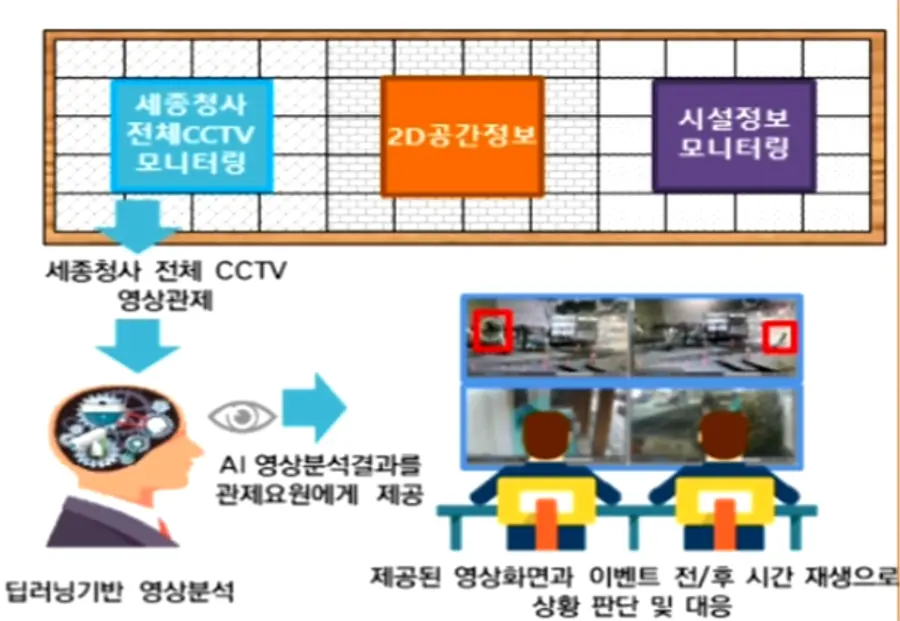
By applying digital twin technology, a "smart integrated control system" will be established that can check not only indoor and outdoor security cameras (CCTV) at government buildings but also the operation status of facilities in real-time.
Currently, the CCTV control room and the facility management room are separately operated, but once the smart integrated control system is established, it can be integrated into one, which is expected to greatly improve efficiency.
In addition, the prevention-oriented control will be enabled as AI selects important video clips first based on AI technology.
2. Establishment of online base for big data
It is expected that a "big data integration platform" will be established to enable the operation of a data-based scientific building.
Currently, data related to the operation of facilities such as heating and cooling of government buildings, lighting, elevators, and automatic entrances and exits are stored separately.
When the integrated big data platform is established, it is expected that accurate statistical analysis will be possible based on information on the overall operation of the building by integrating scattered facility operation information and real-time production data.
It plans to analyze the data collected on the platform to predict facility failures, access, and energy demand, and provide customized services to government office users based on this.
3. Construction of digital services
By introducing a smart visitor guide system, new digital services will be introduced by improving the convenience of visitors and developing platforms linked to mobile ID cards of public officials.
It plans to establish a "Sejong Government Complex Mobile Service" for employees to support real-time mobile app services such as reservation of meeting rooms, restaurant guidance, and inconvenience reporting.
It plans to improve access registration and entry to be more convenient and efficient by installing unmanned guidance (kiosks).
Moreover, it plans to allow access by face authentication without a pass tag.
The Government Buildings Management Office announced that it will invest 15.7 billion won this year to promote smart government building projects and gradually expand them to all government buildings nationwide, reflecting improvement issues.
Cho So-yeon, head of the Government Buildings Management Office, said, "We will continue to discover and supplement customized services centered on the public by establishing smart government buildings amid the trend of digital transformation."
Reported by Smart City Today 스마트시티투데이


![[토큰경제학] 엔비디아의 다음 돈줄은 GPU가 아니라 메모리다](https://cdn.www.smarttoday.co.kr/w400/q75/article-images/2026-06-10/b8779f99-0e61-4370-ab4d-d84e450ee10e.jpg)
댓글 (0)
댓글 작성
댓글을 작성하려면 로그인이 필요합니다.
로그인하기