
Technologies have been developed that can effectively save lives by helping firefighters at indoor disaster sites such as fires, explosions, and collapses.
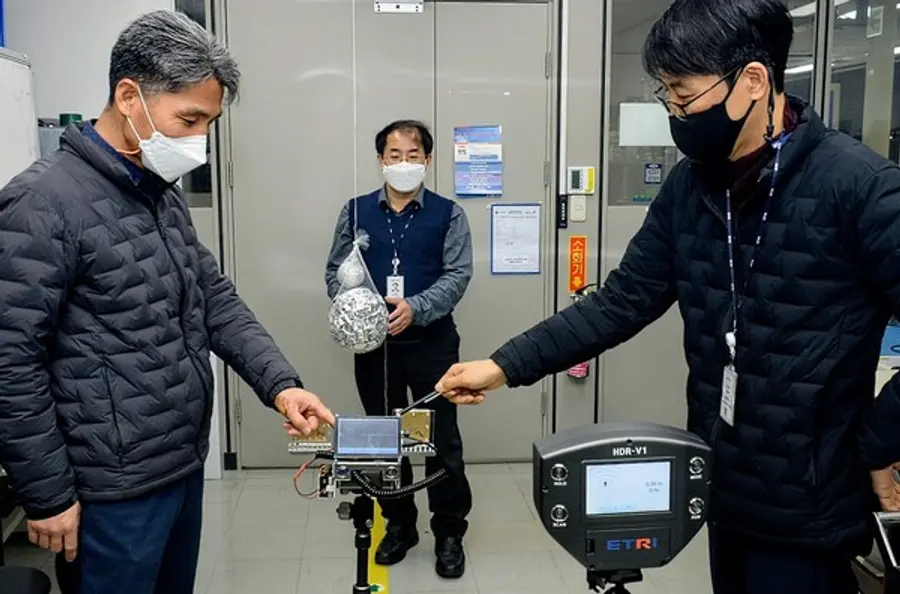
The Korea Electronics and Telecommunications Research Institute (ETRI) announced that it has developed a radar sensor-based human detection system and will produce prototypes to promote living lab demonstration tests to adapt to the site.
The researchers developed a technology that can overcome visual limitations and detect bio-signals such as breathing and heartbeat of victims by using sensor semiconductor technology at disaster sites by putting on a firefighter's helmet or making a portable device.
This technology is expected to be of great help in quickly and accurately saving lives and ensuring the safety of firefighters as it can identify the situation behind the obstacles at the disaster site and the existence of victims using the transmission performance of radio waves.
ETRI researchers have developed two types of radar sensor semiconductors to build a life-detection system.
△The impulse wireless ultra-wideband (IR-UWB) radar sensor can detect biometric signals such as movement, breathing, and heartbeat of victims, which are difficult to check with human eyes, as it can also detect centimeters (cm) of movement using reflected electromagnetic waves.
△High-precision frequency modulation continuous wave (FMCW) radar sensor technology can detect people who fall behind walls or are buried in collapsed debris and breathe without movement.
The researchers are planning to miniaturize the size of the system, which is approximately 15cm x 20cm, to make it easier for firefighters to carry around.
In addition, the researchers plan to make efforts to apply sensor semiconductor-based lifesaving systems to disaster sites, such as promoting simulated demonstration through collaboration with fire-related organizations.
“The goal is to support lifesaving and safe rescue activities for firefighters in the Golden Time in a disaster situation. We will make efforts to quickly apply this technology to disaster sites," said Koo Bon-tae, senior researcher at ETRI.
Meanwhile, this study will be conducted by the end of this year as part of the project "Development of ultra-low-power edge intelligent semiconductor technology based on lightweight RISC-V" with business support from the Ministry of Science and ICT
Reported by Smart City Today


![[토큰경제학] 엔비디아의 다음 돈줄은 GPU가 아니라 메모리다](https://cdn.www.smarttoday.co.kr/w400/q75/article-images/2026-06-10/b8779f99-0e61-4370-ab4d-d84e450ee10e.jpg)
댓글 (0)
댓글 작성
댓글을 작성하려면 로그인이 필요합니다.
로그인하기