
8.7 trillion won will be invested in airport development such as "smart airports" and urban airfields.
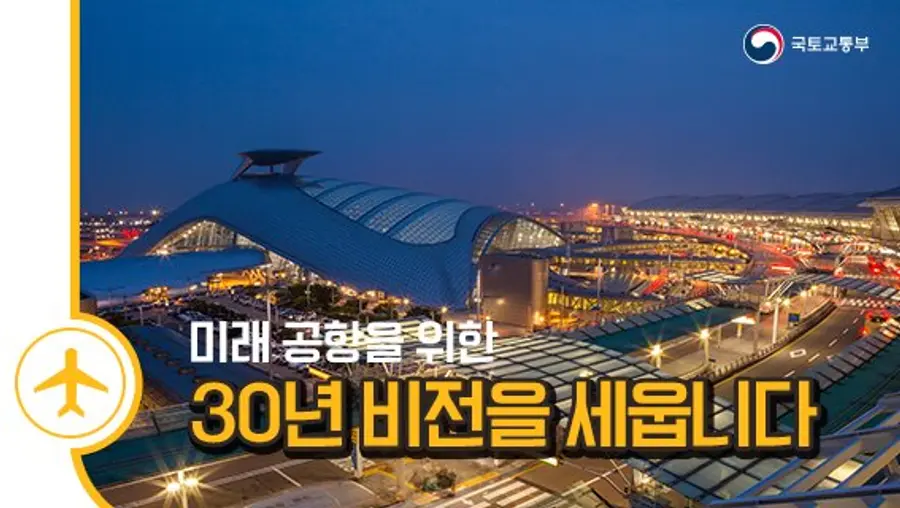
The Ministry of Land, Infrastructure and Transport (Minister Roh, Hyung-wook) announced on the 16th that it finalized the 6th Comprehensive Airport Development Plan (draft) for the next five years (2021-2025) to systematically prepare for flight market uncertainties caused by COVID-19 and proactively respond to future airport issues such as environment and safety.
The 6th Comprehensive Airport Development Plan contains four major implementation strategies to achieve the policy vision of "realizing a people-centered airport that leaps into inclusion and innovation."
The 6th Comprehensive Airport Development Plan consists of ➊the direction and core task of promoting mid-to-long-term airport policies, ➋predicting future airline demand, ➌developing new airports, and developing each airport, including relocation of existing airports.
The main contents of each sector are as follows.
1. Direction and core tasks of policy implementation
◈ By synthesizing the philosophy of state administration, the top-level related plans, and the results of public participation groups, the policy vision of "realizing a people-centered airport that leaps into inclusion and innovation" was presented, and four strategies were prepared to achieve this.
[Strategy ➊] Create an inclusive airport ecosystem
▷ Carbon neutrality
In order to systematically respond to environmental issues, the "Carbon Neutral Airport 2050 Roadmap" will be prepared to establish and manage policy goals and implementation strategies.
In the short term, it plans to develop and gradually expand carbon neutral facilities and operating techniques for each airport, and discover tasks such as establishing environmental management goals in the mid- to long term.
In particular, Incheon International Airport has been decided to be created as the world's best eco-friendly airport.
▷ Managing noise and altitude limitations.
It plans to promote mid-to-long-term noise management core tasks such as presenting preemptive management goals, customized measures for local demand, and disclosure of noise information.
In preparation for the revision of ICAO standards (2024), it plans to prepare for continuous participation in related TF and application measures suitable for domestic conditions, and preemptive discovery and preoccupation of international standard revision issues in the future.
▷ Access Traffic System
The access transportation systems such as shuttle buses, roads, and railroads, will be examined and the mid-to-long-term improvement plans in connection with other infrastructure development plans will be established.
Most of all, the Airport Corporation will expand its role to improve accessibility by reflecting changes in conditions such as the development of nearby cities and the expansion of surrounding infrastructure.
[Strategy ➋ ] Driving growth of national and regional economies.
▷Connecting with regional economic development
The government will promote organic linkage development between airports and surrounding areas to contribute to improving the quality of life for residents and create airports as regional economic bases.
▷ Entering overseas markets
Based on the analysis of global market conditions, the government plans to establish implementation strategies and support plans to support construction and private entry into overseas markets.
▷ Strengthening national competitiveness
Incheon International Airport will expand Terminal 2 and build a new runway to accommodate 100 million passengers a year, and develop complex airport cities such as complex tourist complexes around the airport and business, accommodation, and commerce.
▷ Support balanced regional development
When establishing a development plan, it plans to comprehensively review measures to contribute to the local economy, such as preferential treatment for local companies and development of surrounding areas, and support balanced regional development through airport development in islands.
[Strategy ➌] Prepare for the future by securing innovative growth engines
▷ Prepare a long-term vision.
The government has decided to establish an ‘Airport Vision 2040’ that includes long-term policy goals such as training professionals and suggesting directions for airport technology development.
▷ Smart Airport
It plans to provide advanced services such as non-face-to-face immigration procedures using biometric information and the introduction of airport procedures, develop remote control systems using ICT, and lead international technical standards for unmanned remote control systems.
▷ Air Infrastructure Innovation
In preparation for changes in air transportation methods such as drones and unmanned air vehicles, the concept, size, and installation standards of urban airfields will be prepared. In addition, measures to improve reliability, such as establishing an aviation demand center will be reviewed to verify aviation demand.
▷ Next-generation airport technology
It plans to systematically support and manage R&D tasks in the airport sector (e.g., drone taxis, urban airports, etc.) focusing on the core tasks.
[Strategy ➍] ‘Safety first’ airport management
▷KASS
The detection time will be drastically reduced by establishing a Korean precision GPS location correction system and providing precision services for improving location errors to the entire country.
▷ Improvement of navigation safety facilities
The government decided to introduce high-capacity and high-speed transmission air communication infrastructure, upgrade runway operation ratings, and establish mid-to-long-term plans for navigation safety facilities.
▷ Usage and Working Environment
The government plans to gradually operate wireless signs without actual manpower and review standards for designing and operating new quarantine systems such as installing special quarantine facilities at airports.
▷ Facility maintenance
It was decided to conduct a survey on the actual conditions of old age and performance by airport infrastructure and to establish mid-to-long-term plans related to airport facility performance improvement.
2. Forecasting future airline demand
Based on international organizations' forecasts and scenario analysis by professional research institutes, airline demand forecasts for the next 30 years ('21-50 years) show that by 50, passengers are expected to grow 2.0% per year (2.8% for international flights and 0.7% for domestic flights) and cargo 1.5% per year.
However, it is difficult to completely resolve the uncertainty caused by COVID-19, and the government will continue to monitor demand trends over the next two to three years to supplement them if necessary. Meanwhile, a preliminary scenario was prepared in case a more flexible response was needed.
3. Investment requirements and financing measures
▷ Investment direction
Airport development projects that have previously been planned and need to be carried out as soon as possible will be invested to prepare for the recovery of airline demand after COVID-19, while the planned projects will reflect appropriate expectations by considering various conditions such as aerial demand, changes and needs.
▷ Investment Cost
The total cost of the 6th plan reaches around 8.7 trillion won (*5th plan: 9.2 trillion won).
In the case of facility expansion and maintenance, the government is implementing a four-stage construction project at Incheon International Airport, and the investment cost of new airports is about 4.7 trillion won (national and airport companies).
Meanwhile, planned projects such as Gadeokdo New Airport will be reflected after the total project cost is confirmed through preliminary feasibility studies.
▷ Financing plan
The same procurement principle as the 5th plan will be maintained, but changes will be made if necessary in consideration of changes in national fiscal conditions and construction investment conditions.
Joo, Jong-wan, head of airport policy at the Ministry of Land, Infrastructure and Transport, said, "The plan is characterized by reflecting our airport's future directions such as inclusion, growth, and innovation through various opinions."
Reported by Smart City Today


![[토큰경제학] 엔비디아의 다음 돈줄은 GPU가 아니라 메모리다](https://cdn.www.smarttoday.co.kr/w400/q75/article-images/2026-06-10/b8779f99-0e61-4370-ab4d-d84e450ee10e.jpg)
댓글 (0)
댓글 작성
댓글을 작성하려면 로그인이 필요합니다.
로그인하기