
The Ministry of Science and ICT decided on the Digital Twin Activation Strategy at the 14th Information and Communication Strategy Committee, which was held as a video conference under the presidency of Minister Lim, Hye-sook on Sep 6.
Based on a systematic strategy for revitalizing the digital twin industry and market and leading the technology, the Strategy Committee decided to invest a total of 230.8 billion won in the three core sectors next year to foster 'K-digital twin' to lead the global market.
To this end, the government selected four tasks of ➊creating a foundation for industry growth, ➋creating large-scale leading markets, ➌strengthening competitiveness of technologies, and ➍improving the system to foster the “K-Digital Twin”.
‘Digital Twin’ is a core technology included in the 10 representative tasks of the Korean New Deal and the digital super innovation project of the Korean New Deal 2.0. It is a key technology for realizing a smart city that implements twins that reflect the characteristics of real objects in the same three-dimensional model and utilizes them in decision making such as control and analysis through synchronization simulation with reality.
'Digital Twin' is applicable to various industries, and it is attracting worldwide attention because it can contribute to the reduction of cost and time for decision making and prevention of accidents.
The global market for digital twins in 2020 is 3.5 trillion won, and the domestic market is about 69 billion won, which is still small but is expected to grow at an annual average rate of 70%. (Markets and Markets, based on 2020 analysis)
In particular, major countries are pursuing concrete growth strategies by selecting them as core technologies that determine future national competitiveness. In the UK, the National Digital Twin Program is being promoted, and Singapore is also fostering digital twins as a national task with the Virtual Singapore Project.
In order to establish a strategy for revitalizing the domestic digital twin industry and market in line with this trend, the government has discussed several times with private companies and related ministries and has drawn the following problems and directions.
The government analyzed:
△ Large companies are mostly using foreign SW, so the impact of market spread on the growth of domestic companies is limited, so it is necessary to create an industrial base that can meet the demand for digital twins by domestic SMEs.
△ To expand the outward appearance of the initial market formed through the Ministry of Land, Infrastructure and Transport's spatial information project, such as 3D maps nationwide, precision maps, and integrated maps of underground spaces, it is necessary to urgently create various business opportunities for companies through the promotion of leading projects by fields such as manufacturing, logistics, and medical care.
△ It is necessary to present a blueprint for each detailed service to support the increasingly diverse digital twin demand.
△ It is necessary to develop core element technology and to alleviate the technological gap with leading countries.
In addition, it said that it was necessary to improve the current law and system, such as establishing standards for each common technology and application field and submitting 13,800 pages of 2D drawings for the delivery of domestic fighter jets (KF21) designed and manufactured in 3D to revitalize digital twin utilization.
Based on this analysis, the government established a joint strategy for activating digital twins. The main contents are as follows.
➊ Creating the foundation for digital twin industry growth
△ The government has decided to support the production of 3D objects that are commonly needed by the public and private sectors in order to expand the foundation for digital twin utilization, and provide them through the open platform "AI Hub”.
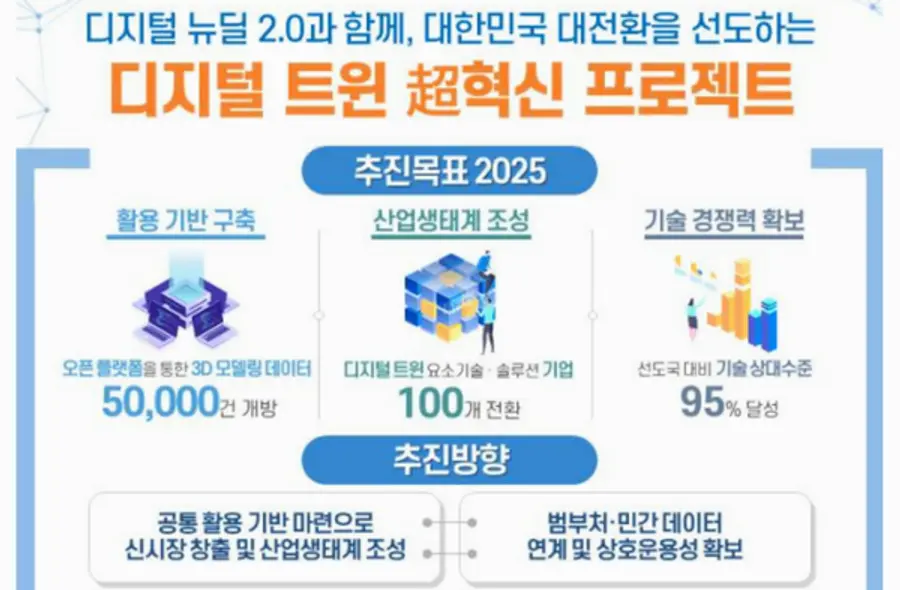
To this end, it will select the demanding field and supply companies for 3D object data, build 50,000 cases of 100 kinds, and open it through AI HUB along with 5,000 twin data built-in existing business.
△ It will also support the development of SaaS for simulations that require the application of engineering elements and push for interlocking and verification through domestic and foreign cloud platforms.
△ Moreover, high-quality 3D spatial information such as terrain and underground spaces will be established for major regions in Korea to meet the growing demand for spatial information due to the development of smart cities and autonomous vehicles.
➋ Creating large-scale leading markets
△ The government plans to streamline production and operation by applying digital twin services by major industries such as manufacturing, logistics, and medical services.
Currently, the government is operating simulations that derive the most efficient process and material mixing ratio optimized for manufacturing products through digital twinization of manufacturing processes of small, medium, and long-term companies.
△ It also decided to introduce a digital twin-based safety management system to prevent various disasters such as floods and safety accidents at industrial sites.
The government has been building a digital twin prediction simulation and preliminary warning system starting this year that synchronizes data collected from the Seomjin River dam and river basin in real-time.
△ In addition, it is planning to improve the operation of buildings and transportation efficiency in cities, which are the main causes of carbon emissions, through digital twins.
➌ Strengthen technology competitiveness
△ The government has decided to establish a roadmap for research and development of digital twin technologies in order to resolve technology gaps compared to advanced countries and preempt future applications early on.
According to the government's analysis, the digital twin technology level/gap in 2020 was Europe(93%, 0.5 years), Japan(87%, 1.3 years), and Korea(82.3%, 1.4 years).
△ Along with this, it will secure an advantage in global technology hegemony competition, develop future core technologies that can reflect demands from the private sector, and discover mid-and large-sized R&D projects. For example, 'Development of Core Technologies' for connection between various digital twin platforms developed in the past.
➍ Standardization and system improvement
△ The government plans to establish standards to establish a data-sharing system essential for providing digital twin services such as spatial information, along with standardization of underlying elements such as terms, models, and evaluation indicators for systematic activation of the digital twin.
△ It will also improve the system so that it can be submitted with 3D data used by digital twins rather than existing 2D drawings when easing regulations and delivering and inspecting products that can promote the use of restricted disclosure data.
For this, the government has decided to ease the "disclosure restriction" data standards prescribed by the National Regulations on Spatial Information Security Management step by step.
Through these four tasks, the government plans to create a foundation for the spread and utilization of digital twin centered on the private sector and lead the market revitalization.
Detail policy goals are ➊establishing and opening 50,000 3D object data, ➋conversion of 100 companies related to the digital twin, and ➌ a 95% level achievement of technology relative to leading countries.
Through this, small and medium-sized suppliers plan to develop and provide services more easily, and demand companies plan to create a "private-led digital twin ecosystem" where they can access digital twins as a convenient and inexpensive TaaS(digital Twin As A Service).
Reported by Smart City Today


![[토큰경제학] 엔비디아의 다음 돈줄은 GPU가 아니라 메모리다](https://cdn.www.smarttoday.co.kr/w400/q75/article-images/2026-06-10/b8779f99-0e61-4370-ab4d-d84e450ee10e.jpg)
댓글 (0)
댓글 작성
댓글을 작성하려면 로그인이 필요합니다.
로그인하기