
The Ministry of Science and ICT (MIST) and the National Research Foundation of Korea selected Professor Hyung-sook Kim’s team from the Department of Intelligence and Computing at Hanyang University as the research organization for ‘digital therapeutics for emotional disorders’ for the post-Covid era, on the 15th.
aims to develop a digital treatment platform that prevents and manages ‘mental-demic’ such as depressing caused by non-face-to-face situations due to COVID 19, and a total of 28.9 billion won (Government 14 billion won and private sector 14.9 billion won) will be invested in the team for 4 years until 2024.
The reason the MIST has supported the development of a digital treatment platform is that according to a survey by the National Health Insurance Corporation in Korea, the number of depressive patients increased by 5.9% from 750,000 in 2018, to 790,000 in 2019, and medical expenses are also increasing by 12%. The number of depressed patients due to ‘mental-demic’ is expected to increase further due to activity restrictions, economic recession, and anxiety caused by COVID-19.
This research will play a key role to solve social problems caused by mental illness, by developing and providing digital therapeutics to prevent depression or treat patients non-face-to-face.
Digital therapeutics is a promising technology that is expected to grow from $2.12 billion in 2018 to $9.64 billion sizes by 2026 to prevent, treat, and manage diseases such as hyperactivity disorder (ADHD), dementia, epilepsy, and obsessive-compulsive disorder using software such as games, virtual reality/augmented reality, chatbots, and artificial intelligence (AI).
In particular, the development of digital treatment requires the convergence of Korea's strong technologies such as biotechnology (BT) and information and communication technology (ICT). Based on this investment, it is expected to secure international competitiveness in the future.
Meanwhile, researchers from various fields such as artificial intelligence, mental health clinical and cloud computing will participate in this research, led by Professor Hyung-sook Kim’s team at Hanyang University, a behavioral science expert.
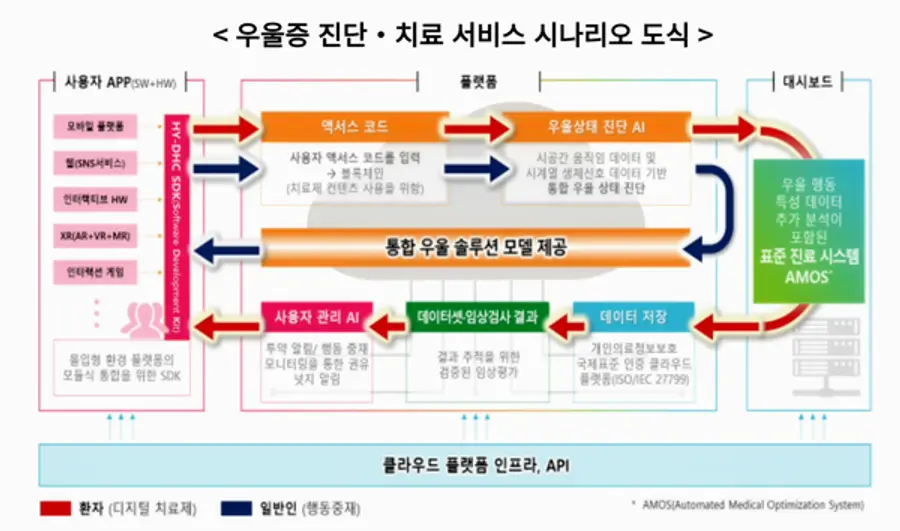
Professor Hyung-sook Kim’s team plans to build a depressive behavioral characteristic dataset through a digital therapy based on physical activity and cognitive brain science, and analyze and standardize so that collected data is automatically linked on cloud computing.
In addition, the team of Professor Bo-hyung Han of the Department of Electrical and Computer Engineering at Seoul National University is in charge of upgrading the AI algorithm for depression diagnosis through self-supervised learning, transfer learning, and attention-based feature integration using various data collected during the research process.
At the same time, the team of professor Hong-Jin Jeon of the Department of Psychiatry at Samsung Seoul Hospital, a clinical expert, will execute clinical validation and trials as well as the research on a medical standardization system linking clinical trials and digital treatment platform for approval of depression digital treatments.
The research results of this expert team will lead to the establishment of a non-face-to-face emotional disorder digital treatment platform and cloud infrastructure and digital treatment business ecosystem for clinical verification through the team of director Jae-Jun Ryu of NAVER Cloud, a cloud computing expert. Through this, it will enable individual-optimized depression diagnosis and treatment services for each individual.
The general public who wants to prevent depression will also be able to use the depression diagnosis and treatment services using various digital devices such as mobile phones and tablet PCs.
At a meeting attended by the National Research Foundation of Korea and the head of research, "Third-generation treatments, such as digital therapeutics and electronic drugs, have fewer side effects from chronic administration, unlike conventional treatments, and personalized treatment is possible through real-time monitoring and feedback, which is an essential technology for improving public health. As it is a new concept treatment, we will solve the institutional difficulties encountered in the research process with related ministries such as the Ministry of Health and Welfare and the Ministry of Food and Drug Safety,” said Hong-taek Yong, 1st Vice Minister of the National Research Foundation.
Reported by 'Smart City Today'


![[토큰경제학] 엔비디아의 다음 돈줄은 GPU가 아니라 메모리다](https://cdn.www.smarttoday.co.kr/w400/q75/article-images/2026-06-10/b8779f99-0e61-4370-ab4d-d84e450ee10e.jpg)
댓글 (0)
댓글 작성
댓글을 작성하려면 로그인이 필요합니다.
로그인하기