
The government will expand support to achieve 166 trillion won in sales in the secondary cell battery industry by 2030.
By 2030 the private sector will 40.6 trillion won and the government will expand technology preoccupation support such as large-scale R&D pre feasibility study to acquire the world’s best competitiveness in rechargeable battery technology.
In addition, by selecting core technology of secondary battery as a nation’s strategic technology, benefits such as tax credit for R&D up to a maximum of 40~50% and facility investment up to a maximum of 20% will be provided.
The government announced the ‘K-battery development strategy’ containing these contents to make a leap to the world’s No.1 battery country at the site of LG Energy Solution’s second plant in Ochang on July 8.
This strategy was designed to unite the capabilities of the government and private sector to prepare for the fierce competition in the future as major countries such as the U.S., Europe, and China are building manufacturing bases and strengthening battery technology as the secondary battery industry is expected to grow rapidly.
The 'K-battery development strategy' includes the contents that three battery companies and component-making companies invest more than 40 trillion won by 2030, and the government will support R&D, taxation, and finance.
The government has also decided to promote large-scale R&D to acquire the no.1 technology for next-generation rechargeable batteries. The plan is to boost the commercialization of next-generation secondary batteries such as lithium-sulfur batteries by 2025, all-solid-state batteries by 2027, and lithium metal batteries by 2028, and to develop core technology for the component making of the batteries.
In particular, the government announced that it will strengthen tax support such as a maximum of 40-50% for R&D and a maximum of 20% for facility investment as secondary battery core technology is a nation’s strategic technology. In addition, it is planning to exempt foreign businesses from liquidation and reduction requirements when investing in facilities to support investment incentives that correspond to domestic returning companies.
Moreover, the government decided to acquire overseas raw materials and strengthen domestic recycled material production capacity to create an ecosystem of solidarity and cooperation to build a global leading base. To this end, they decided to support private overseas material and mineral development projects, strengthen cooperative channels with resource-holding countries, improve stockpiling systems, and promote technology for securing raw materials through recycling secondary batteries.
It will also build an industrial ecosystem around the small components specialized complex designated in February this year, provide 80 billion won in innovation funds jointly funded by three battery companies and the government, tax credit through the designation of national strategic technologies, and incentives under the revised domestic returning law.
The government will increase the number of master's and doctorate-level design and advanced analysis personnel and train more than 1,100 professionals annually through ‘basic, application+specialization, and technical difficulty resolution education’ as well.
Meanwhile, as markets for secondary batteries are expected to expand after use, a method to create demand in this field has been prepared. Starting next year, the government will start releasing waste batteries for electric vehicles that are secured through subsidies and foster industries throughout the process of retrieving used batteries → collection and transportation → storage→ sale → performance evaluation → utilization and commercialization.
The plan aims to create a new private and public markets such as drones, ships, machinery, and public ESS where secondary batteries can be applied, and to discover and foster new industries so that new business models such as rental and replacement services can be created.
"If semiconductors are like the head of our body, batteries are the heart, the source of power," said Seung-wook Moon, the Minister of Trade, Industry and Energy. "The government will provide comprehensive support to grow secondary battery to another flagship industry of Korea like semiconductors."
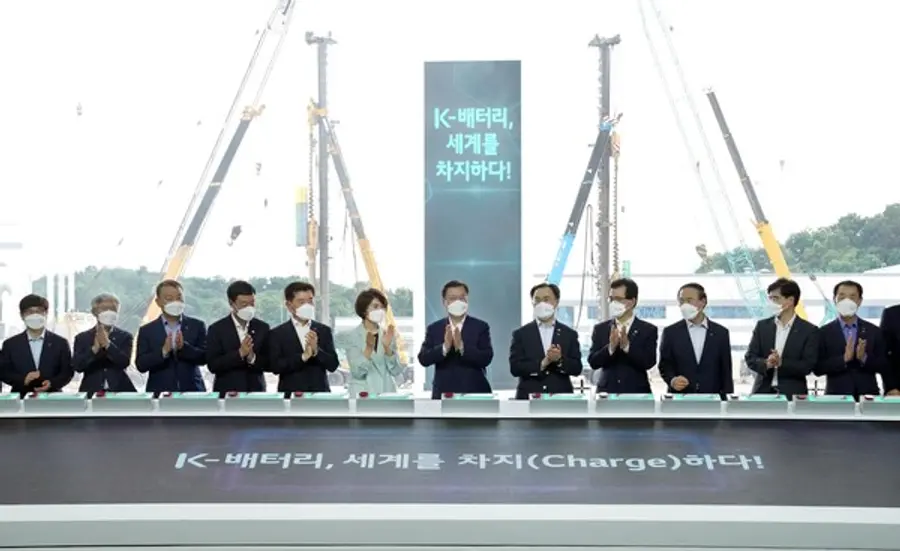
Reported by 'Smart City Today'

댓글 (0)
댓글 작성
댓글을 작성하려면 로그인이 필요합니다.
로그인하기