
In preparation for the 6G commercialized era in 2030, the government will invest 220 billion won in 6G core technology development to lead international standards.
The Ministry of Science and ICT held a ‘6G Strategy Meeting’ in public-private partnership and established a 6G R&D plan on June 23rd.
“The next generation of mobile communication network will be the foundation of digital innovation,” said Lim Hye-sook, the Minister of Science and ICT. “Based on our experience and know-how in the network field, we -the private sector and the government- need to take a bold and challenging role in leading the global market in the 6G era.”
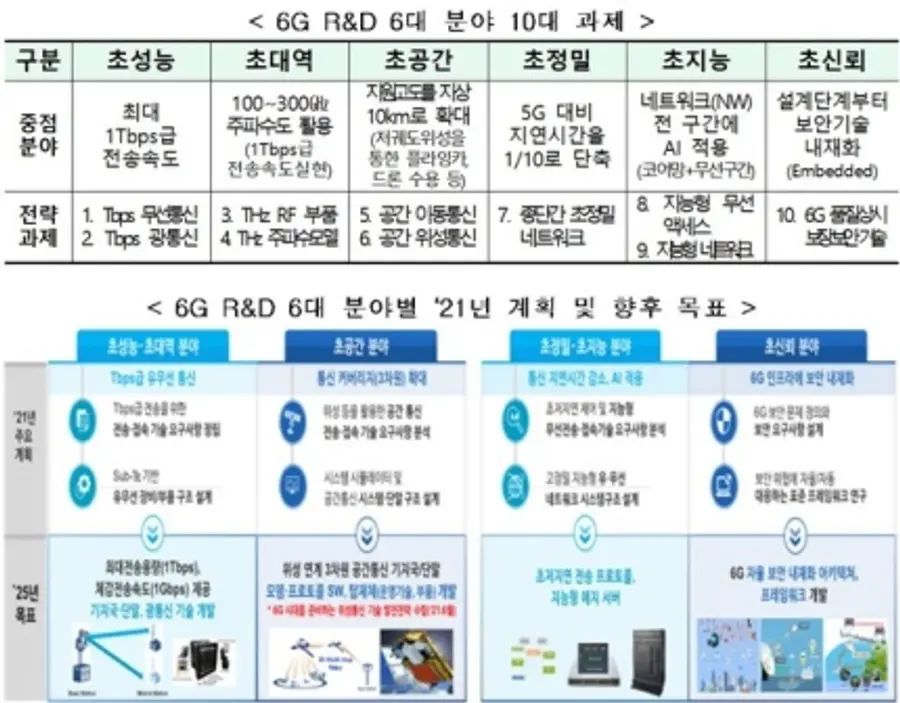
The Ministry of Science and ICT plans to invest 200 billion won by 2025, 17.9 billion won (12 projects) as of this year, in 10 strategic technologies in six key areas, such as low-orbit communication satellite and ultra-precision network technology, which the private sector cannot actively invest, in order to secure next generation source technology.
The 6G R&D implement plan includes ▲securing core source technology for the next generation ▲preoccupying international standards and patents ▲establishing research and industrial infrastructure as the 3 strategic areas to become the world’s best 6G technology powerhouse.
The six key areas of core technologies are ▲ultra-performance ▲ultra-band ▲ultra-space ▲ultra-precision ▲ultra-intelligence ▲ultra-reliability, and 10 tasks have been set regarding these areas.
In particular, the integration of satellite and terrestrial networks will be promoted so that Gbps-class communication of flying vehicles such as flying cars and drones can be used even at sea and disaster areas for the 6G era.
The government plans to designate and operate 6G research center in three universities this year to train master’s and doctoral level human resources.
Small and medium-sized domestic enterprises, domestic universities and research institutes will participate in R&D jointly.
In addition, to secure core 6G technology, the government plans to continue public-private cooperation activity with three subcommittees: technology∙standardization, satellite∙frequency, and global.
Also, the Institute of Information & Communications Technology Planning & Evaluation (IITP) and National Science Foundation (NSF) signed a business agreement for joint research cooperation, and decided to promote the research in 6G field starting this year in order to expand global exchanges.
At the Korea-US summit held at the White House in Washington, DC on May 21st (local time), the two countries promised to build a future-oriented partnership for 6G and to expand cooperation such as joint research.
Moreover, joint research on 6G core technology with the United States (NSF), China (CAICT) and Finland (University of Oulu), which are currently conducting state-led 6G preemptive research, and international cooperation on 6G frequencies will be promoted.
“Since the foundation for cooperation between the two countries has been well established at the Korea-US summit, we will make good use of this and promote global collaboration from the early stage of 6G preparation,” said Lim Hye-sook, the Minister of Science and ICT. “We will work closely with related ministries as well as large and medium-sized enterprises to secure Korea’s future and enhance its status as a digital powerhouse.”
Reported by 'Smart City Today'



댓글 (0)
댓글 작성
댓글을 작성하려면 로그인이 필요합니다.
로그인하기