
[Smart City Today]
The Ministry of Land, Infrastructure and Transport and the Korea Transportation Safety Authority conduct the pilot operation of ‘T-Safer(Transportation Safety Keeper)’, a program that predicts and warns the risk of traffic accidents based on AI on the national roads.
T-Safer is a traffic accident prediction system that analyzes accident risk factors and provides solutions using AI based on big data related to traffic safety and is the first system developed by the Korea Transportation Safety Authority and KAIST.
Since May, the Iksan regional construction and management office and the Korea Transportation Safety Authority have developed a T-Safer system to predict the risk of traffic accidents by setting a 48km route between Yeosu and Suncheon on National Route 17 and 23km between Jeonju and Iksan on National Route 21 as pilot project roads.
The analysis and utilization process of T-Safer is as follows.
▶Construction of Traffic Safety Big Data
Big data is built by integrating traffic safety-related data scattered by institutions such as △ driver operation characteristic information, △GIS information △traffic accident information, △ speed information, △ vehicle operation information, △ Pedestrian information, △ road facility information, and △ city, weather, and population information.
▶Traffic Accident Risk Prediction
By dividing road sections into 500m links and analyzing big data, the risk of traffic accidents in each section is classified into 0 (low) to 4 levels (high) in consideration of the probability and severity (death, serious, and slight injury), and displayed on the traffic safety risk map.
▶Providing Traffic Safety Solutions
Among the divided links, the section with a risk level of 3 or higher will be provided to the road operator by the 15th of every month, with the analysis of risk factors such as human factors, violations, number of accidents, vehicle elements, transportation facilities, and walking frequency.
▶Utilization of safety measures
Priorities for improving traffic safety can be determined by referring to reports containing solutions used to prevent traffic accidents.
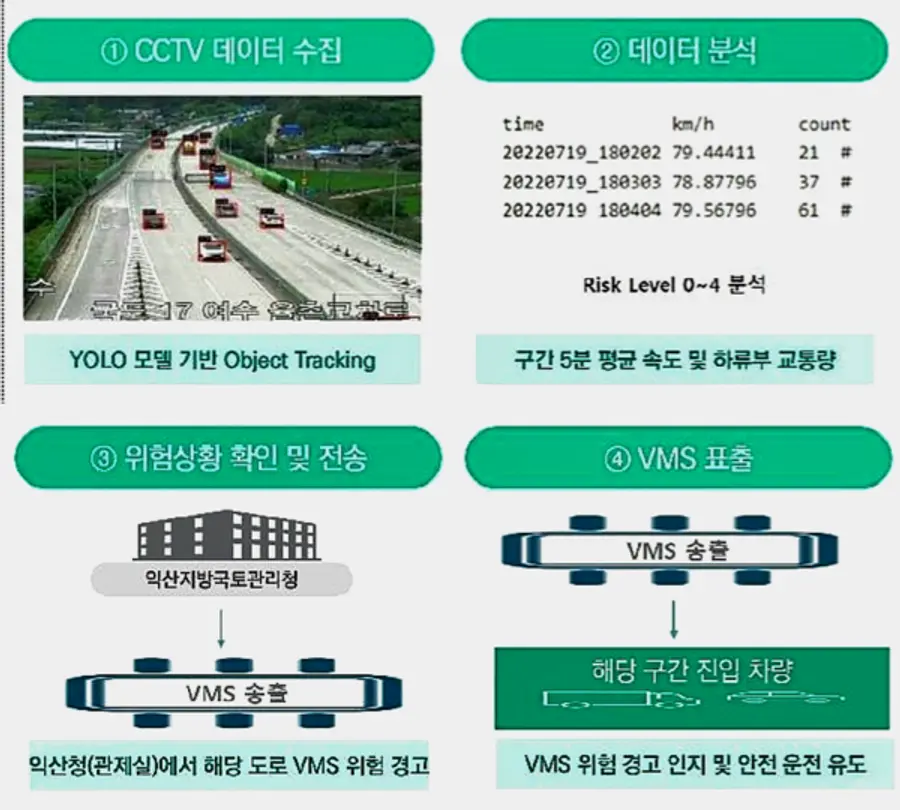
In addition, the T-Safer system analyzes car speed, traffic volume, and dangerous driving behavior based on CCTV screens to inform drivers of the risk of traffic accidents through VMS in real-time when the risk of traffic accidents increases.
The Ministry of Land, Infrastructure and Transport and the Korea Transportation Safety Authority plan to expand T-Safer to various fields such as other national highways and urban areas, depending on the results of the pilot operation on the national roads.
Moreover, T-Safer will be implemented on the platform in the long run so that it can promote consistent and scientific safety management even if traffic safety officials change.
Yoon Jin-hwan, Director General for Comprehensive Transport Policy of the Ministry of Land, Infrastructure and Transport, said, "We have used a post-traffic safety management method such as improving road structure after traffic accidents so far, but T-Safer is a proactive and preventive traffic safety management system, so it is very meaningful." And "We will actively make efforts to realize a safe country from traffic accidents by removing traffic accident risk factors in advance."


![[토큰경제학] 엔비디아의 다음 돈줄은 GPU가 아니라 메모리다](https://cdn.www.smarttoday.co.kr/w400/q75/article-images/2026-06-10/b8779f99-0e61-4370-ab4d-d84e450ee10e.jpg)
댓글 (0)
댓글 작성
댓글을 작성하려면 로그인이 필요합니다.
로그인하기