
The Seoul Metropolitan Government (SMG) will launch a pilot project to expand and apply wireless charging technology for city buses that circulate through the downtown.
▲ Namsan circulation bus (No. 01) and ▲ Cheonggyecheon self-driving bus, which are scheduled to operate in the second half of this year, will complete the construction of infrastructures such as charging devices by the end of this year and wireless charging technology will be introduced in earnest from next year.
The SMG said it will expand wireless charging technology as electric vehicle battery performance and wireless charging technology have developed over the past 10 years since the first introduction of wireless charging technology to elephant trains in 2011.
Domestic wireless charging technology is currently capable of high-capacity fast charging of more than 150 kWh, and electric large buses can run more than 21 kilometers if they are charged for about 6 minutes.
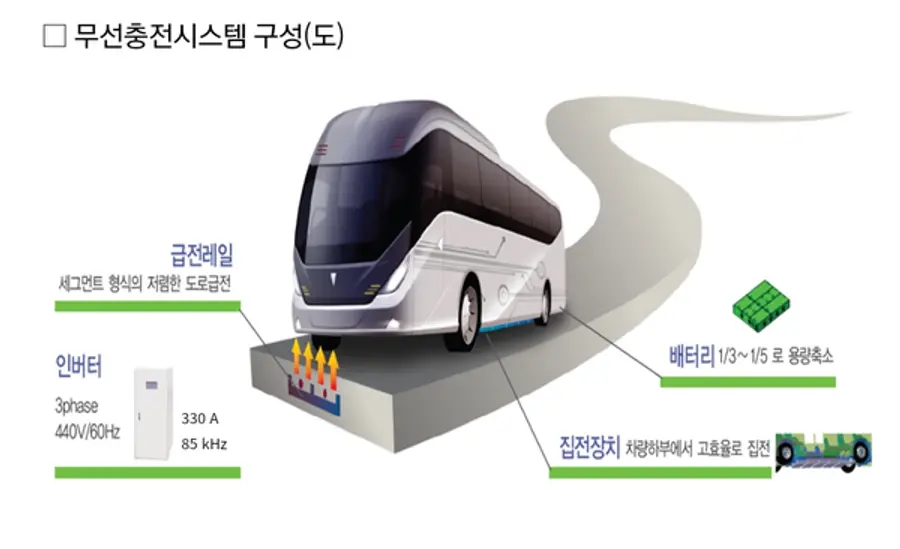
When a wireless charger (transmitter) is buried at a bus stop or under the ground, a vehicle equipped with a wireless charger (receiver) stops nearby and is charged wirelessly through resonance frequency.
Unlike wired charging, it is easy to charge just by parking and stopping without having to connect a heavy connector to a vehicle or operate a separate charger, and it is convenient for drivers who have difficulty moving.
The wireless charging technology of the pilot project is a method in which wireless chargers are buried at stops or garages, and vehicles with wireless chargers can be charged when they stop using 85 kHz band frequencies.
The SMG plans to install a wireless charger (transmitter) on the road of Cheonggye Plaza, the turning point, and the self-driving bus is charged with a wireless charger (receiver) while stopping during waiting times such as getting on and off.
The Cheonggyecheon self-driving bus operates a 4.8km route that starts from Cheonggye Plaza and runs around Cheonggye 5-ga and it is scheduled to start operation in the second half of this year.
It has a charging capacity of 20kWh and can run 6km in about 6 minutes, so it can run on a circular route without a separate wired charging. It is expected that actual autonomous driving can be implemented if not only operation but also charging are carried out unmanned.
Namsan circulation bus (No. 01) is operated by installing a wireless charger (transmitter) on the floor of the Namsan Seoul Tower bus stop and garage so that the driver stops and charges during break times. The SMG is planning to attach wireless charging devices (receivers) to one or two of the existing electric buses.
Namsan circulation bus (No. 01) is an electric bus that circulates (about 16 kilometers) between Yejang Transfer Parking Lot, Cheongwadae, and Namsan Seoul Tower.
The wireless charging capacity will be designed at 150 kW in consideration of the electric bus battery capacity, enabling fast charging. It can run more than 21km when charging for about 6 minutes, so it is possible to operate the route without wired charging.
After evaluating the results of the pilot project, the SMG will consider the further expansion to self-driving cars, sharing cars, and electric buses.
If wireless charging is expanded, public transportation such as buses and taxis will be able to be charged from time to time while passengers are getting on and off and even while driving. It is expected the transition of public transportation vehicles to electric will be preferred in case the convenience of charging electric vehicles is widely expanded.
Yoo Yeon-sik, head of SMG’s Climate and Environment headquarters said, "If the demonstration of wireless charging is completed and commercialized through the pilot project, it is expected to be an alternative to solve the problem of installing charging stations due to the conversion of electric buses. The Seoul Metropolitan Government will actively support the development and distribution of new technologies to enhance electric vehicle charging convenience so that it can become a leading city in the supply of electric vehicles.”
Reported by Smart City Today


![[토큰경제학] 엔비디아의 다음 돈줄은 GPU가 아니라 메모리다](https://cdn.www.smarttoday.co.kr/w400/q75/article-images/2026-06-10/b8779f99-0e61-4370-ab4d-d84e450ee10e.jpg)
댓글 (0)
댓글 작성
댓글을 작성하려면 로그인이 필요합니다.
로그인하기