
Seoul Metropolitan Government has decided to invest 345.9 billion won this year in building infrastructure for smart administrative services such as Metaverse, Big Data, and AI.
In particular, it announced the plan to invest 112.6 billion won (253 cases) in the "smart city".
In addition, in line with the digital transformation era, new technologies such as metaverse, big data, and artificial intelligence (AI) will be introduced into administrative services to increase citizens' convenience and effectiveness.
It will also increase "intelligent CCTVs" that combine artificial intelligence (AI) to expand citizen safety nets and strengthen educational projects that embrace the digital vulnerable so that they are not alienated.
Projects and budgets in the smart city sector are as follows. △ Big Data (13.2 billion won) △ Artificial Intelligence (5.3 billion won) △ CCTV (3.7 billion won) △ Wi-Fi (6.3 billion won) △ Internet of Things (7.2 billion won) △ Blockchain (1.1 billion won) △ Metaverse (7 billion won) △ AR·VR (1.6 billion won) △GIS (1.56 billion won) △Untact (2.1 billion won) △Mobile (11.6 billion won)
By institution, △ Seoul City 175.3 billion won (399 cases) △ 25 autonomous districts 106.7 billion won (548 cases) △ 63.9 billion won (120 cases) for investment and contribution institutions, △ 78.4 billion won (67 cases) for system construction △ 56.8 billion won (178 cases) for SW development.
The timing of business orders will be 457 cases (43%) in the first quarter of △ 120 (11%) in the second quarter and 32 (3%) after the third quarter. Through this, the government plans to create 3,494 jobs (applying the Bank of Korea's employment inducement coefficient) to secure youth jobs that have been stagnant due to COVID-19 and drive the growth of small and medium-sized ICT companies. In particular, 577 cases (54%), or about half, will be ordered in the first half to contribute as much as possible to revitalize the economy.
Meanwhile, the 458 cases, including maintenance order placement completed in 2021, has been effective since January 1 this year, and in the second half of this year, 2023 to implement projects will be ordered.
The main contents of this year's informatization project in Seoul consisted of expanding public services using △ Metaverse and virtual reality technologies △ providing digital administrative services that combine new technologies such as big data and artificial intelligence △ expanding digital vulnerable groups.
First, in line with the global trend in the post-COVID19 era, a total project cost of 7 billion won will be invested in the utilization of metaverse technology.
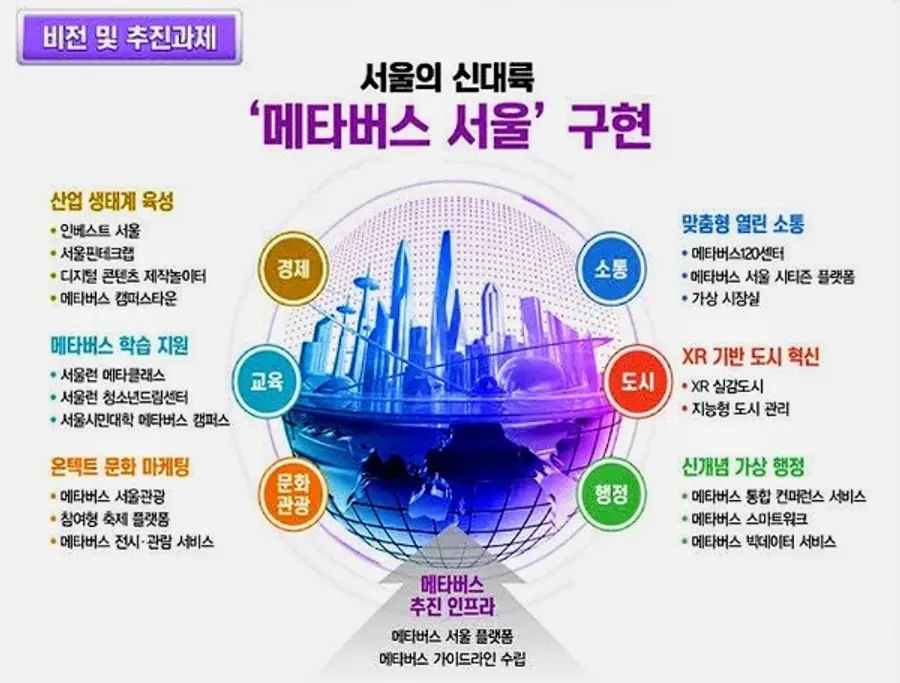
For the first time in a local government, the city's own metaverse platform, Metaverse Seoul (tentative name), will be established to diversify non-face-to-face communication channels. It also plans to actively discover and provide realistic content using virtual reality technology (VR) and AR.
Metaverse Seoul (tentative name) plans to create a metaverse ecosystem in all areas of the city administration, including economy, education, culture, tourism, and civil complaints, in three stages starting this year.
Moreover, museums and major landmarks in the city will use virtual reality technology (VR and AR) to provide real content so that citizens can enjoy it realistically anytime, anywhere without visiting the target site.
Secondly, it plans to provide a higher level of digital administrative services by converging and applying new technologies such as big data, artificial intelligence (AI), the Internet of Things (IoT), and blockchain throughout the city and has set 67.7 billion won in project costs in related fields.
A representative example is the establishment of a "big data service platform" that collects, analyzes, and displays public big data in △ Seoul Metropolitan City △ Advanced AI Waterworks Civil Service Consultation service that is currently in operation.
A project to expand the scope of the 'blockchain-based Seoul wallet app' service, which stores and utilizes 100 kinds of government-issued certificates such as resident registration certificates and Corona vaccination certificates, is also planned, as well.
Third, it plans to make more efforts to expand the safety net for citizens by expanding and installing intelligent CCTVs to prevent the disappearance of the elderly with dementia. The cost of investing in related fields increased by 6.2 billion won year on year to 37.9 billion won.
Typically, △ the establishment of a 'dementia elderly disappearance prevention system' that grasps the location of the elderly with dementia by watching CCTV images after AI learns face information △ the installation of CCTV surveillance video that detects Han River investment in Yanghwa, Dongho, and Wonhyo Bridge △ the construction of a 'construction site visual intelligence system' that analyzes CCTV at the construction site and immediately alerts the site manager in case of a dangerous situation.
Fourth, it will take the lead in realizing a digital inclusion society through continuous education of the digitally vulnerable groups such as the elderly and the disabled.
In particular, it will provide the education necessary for daily life, such as how to order kiosks in stores, which is increasing due to the expansion of non-face-to-face, and set 2 billion won as input costs in related fields.
As a representative project, △ Seoul Digital Competency Enhancement Education △ Informatization Education for each local government was prepared.
Seoul Smart City Policy Officer Park Jong-soo said, "We are facing a new era that has not been experienced before due to the transformation of Corona Pandemic and ICT technology," adding, "We will increase convenience and effectiveness throughout citizenship by expanding new concept administrative services through digital technology."
Reported by Smart City Today


![[토큰경제학] 엔비디아의 다음 돈줄은 GPU가 아니라 메모리다](https://cdn.www.smarttoday.co.kr/w400/q75/article-images/2026-06-10/b8779f99-0e61-4370-ab4d-d84e450ee10e.jpg)
댓글 (0)
댓글 작성
댓글을 작성하려면 로그인이 필요합니다.
로그인하기