
[Smart City Today]
The vehicle-to-vehicle(V2V) fast charging service, which can distribute the remaining electricity used in the electric vehicles to another vehicle, is expected to start soon.
It is like how you get help from other vehicles with a jump starter when discharging a car battery, but in some cases, rental cars, etc., it heralds the creation of a new type of business model that shows potential for development into a profitable model that can sell the remaining electricity to other vehicles.
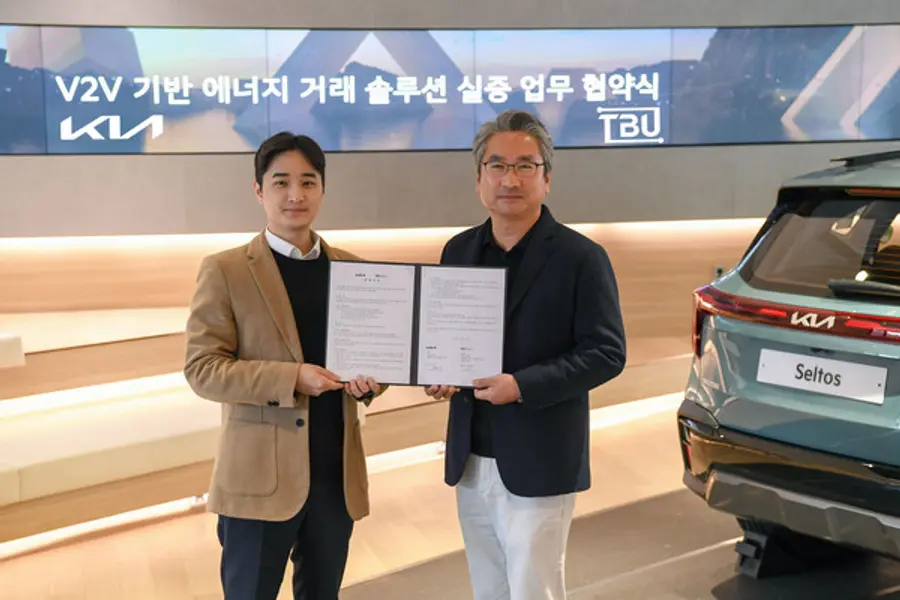
Kia recently announced that it will secure profits through charging and discharging energy transactions of customers who purchase electric vehicles along with TBU, an electric vehicle charging start-up while demonstrating a solution to zero charging time for consumers.
Kia announced that it signed a business agreement at Kia 360 in Apgujeong, Seoul, to demonstrate energy transaction solutions based on V2V (Vehicle to Vehicle) fast charging technology, attended by major officials, including Baek Sang-jin, CEO of TBU, and Yoon Seung-kyu, head of Kia's eBiz solution division, etc.
The V2V fast charging is a technology that enables fast charging between electric vehicles, which are currently on a steady increase in sales, and uses the vehicle's internal system to allow charging and discharging between vehicles when connecting charging ports of electric vehicles with cables.
TBU is a startup that provides an electric vehicle charging platform "Elecvery” and is about to launch a mobile electric vehicle charging service after obtaining approval from the Ministry of Trade, Industry and Energy for a special regulatory sandbox demonstration. It also provides specialized solutions through data analysis, such as an AI-based charging demand and supply matching optimization algorithm and charging station operation efficiency prediction service.
Kia is currently developing a new fast charging technology between vehicles that dramatically reduces charging time and vehicle renovation costs compared to mobile charging services [1] using trucks on the market. If commercialized, customers who purchase Kia electric vehicles can generate profits through charging and discharging power transactions [2].
If these energy transactions expand into the platform business, individuals can secure profits through the resale of power remaining in the vehicle. Charging businesses can secure subscription-type services, and taxi and rental car companies can secure additional profit models using idle time. It is characterized by the disappearance of big restrictions on the use of electric vehicles as final consumers do not need to travel and wait to install and charge at charging infrastructure.
Through this business agreement, Kia and TBU plan to continuously verify the △ reduction of charging time felt by customers who own electric vehicles, △ securing profit models through power resale, and △ platform business scalability to revitalize the energy market.
Kia said that the new fast-charging technology is an optimized solution in Korea with high scalability and a high ratio of apartments to platform businesses when lifting energy-related regulations and plans to continue various demonstration tasks to address the unmet needs of EV customers.


![[토큰경제학] 엔비디아의 다음 돈줄은 GPU가 아니라 메모리다](https://cdn.www.smarttoday.co.kr/w400/q75/article-images/2026-06-10/b8779f99-0e61-4370-ab4d-d84e450ee10e.jpg)
댓글 (0)
댓글 작성
댓글을 작성하려면 로그인이 필요합니다.
로그인하기