
The Ministry of Science and ICT and Gwangju Metropolitan City held a steering committee for the Gwangju Artificial Intelligence-centered Industrial Convergence Complex Project (hereinafter referred to as the Gwangju K-AI Integrated Complex Project) on January 24 to confirm the 2022 project plan worth 107.6 billion won and to promote the project in earnest.
The Gwangju K-AI integrated complex project is a key task of the "National Balanced Development Project" and "Artificial Intelligence National Strategy" to promote the convergence of Gwangju's major industries (auto, healthcare, energy) and artificial intelligence (AI) for five years from 2020 to 2024.
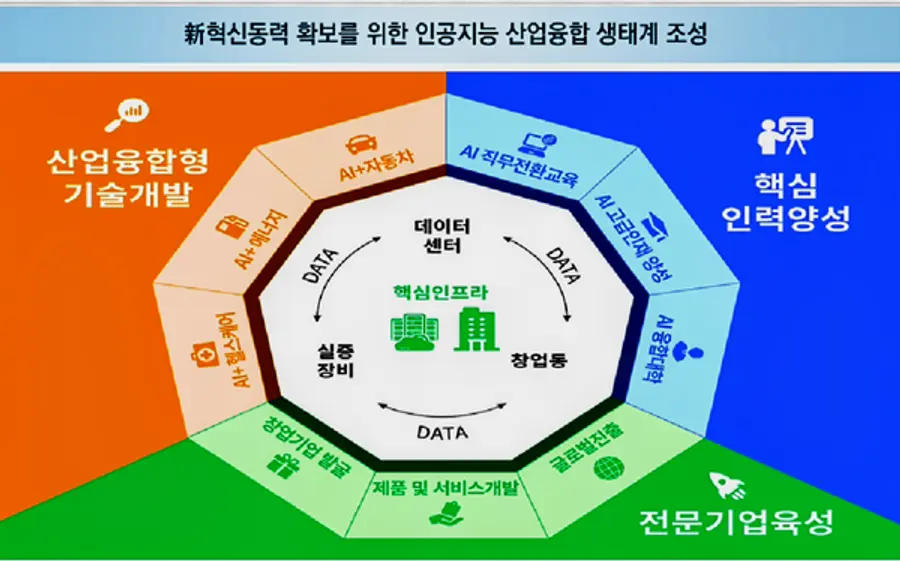
It is a project to create an artificial intelligence convergence ecosystem by promoting the convergence of artificial intelligence (AI) with Gwangju's main industries (automobiles, healthcare, energy) and by concentrating various infrastructures, businesses, talents, and technologies such as data centers by investing a large budget of KRW 411.9 billion over five years from 2020 to 2024.
This year is the third year and the AI data center will be completed, and the K-AI integrated complex will be completed next year.
Through this project, 92 AI companies were engaged, 292 specialized companies were supported, 1,254 core workers were educated and nurtured, 436 new jobs were created, and as a result, Gwangju is rapidly transforming into an AI innovation base of the country.
The main contents of this year's "Gwangju K-AI Integrated Complex Project," which was confirmed on the day, are as follows.
❶ Key Infrastructure Development Part
It supports AI-specific data centers that provide high-performance computing resources needed to develop AI products and services (2022: 8.85PF 2024: 88.5PF), support demonstration equipment that provides test equipment for the three major industries. (2022: virtual test equipment for autonomous vehicles → 2024: 77 types)
This year, it plans to support a total of 150 companies, including 100 high-performance computing resources and 50 demonstration equipment.
PF (PetaFlops) refers to 1,000 trillion operations per second.
❷ Field of fostering AI companies
It plans to support a total of 99 companies this year by customizing start-up mentoring, prototype production, investment funds, and overseas expansion necessary for each growth stage of companies such as preliminary start-ups, start-ups, and growth.
▷Support for prospective entrepreneurs
Start-up competition, commercialization consulting and mentoring, AI technology and start-up education.
▷Support for AI-specialized start-ups
Support for moving into AI start-up camps, production of prototypes and services, investment funds, and product advancement.
▷Support for the growth of AI companies.
Support for AI product and service quality improvement test and overseas expansion.
❸ AI core human resource training field
In order to respond to various demands from companies, customized education programs will be provided for each stage of human resource growth, including undergraduate, incumbent student, job seekers, and high-quality talents, and a total of 1,260 people will be educated and nurtured this year.
In order to foster manpower that can promote the convergence of artificial intelligence with the three major industries, the company selected four major universities last year and is operating a major course in AI convergence and plans to educate a total of 760 people this year.
In addition, it plans to train total of 500 people, 200 online and offline customized AI direct conversion training to strengthen the field practical skills of incumbent and job seekers, 300 artificial intelligence schools that train young people who are about to get a job.
❹ Industrial Convergence Technology Development
It has been supporting 14 R&D projects that incorporate AI technology into three major industries since last year.
Meanwhile, the Ministry of Science and ICT and Gwangju City plan to systematically plan a second phase of the project from 2025 to 2029 in accordance with the direction of the artificial intelligence regional confidence announced by the 25th The Fourth Industrial Revolution Committee last year.
“We plan to actively support the Gwangju artificial intelligence complex to be developed as a key base for national artificial intelligence that creates new industries and jobs in the COVID-19 era”, said Ryu Je-myung, an artificial intelligence-based policy officer at the Ministry of Science and ICT.
“Gwangju, which has been leading the era with the Gwangju Artificial Intelligence Complex Project, will make an artificial intelligence innovation model in Korea and become a representative city of artificial intelligence,” said Son Kyung-jong, director of artificial intelligence industry in Gwangju Metropolitan City.
Reported by Smart City Today


![[토큰경제학] 엔비디아의 다음 돈줄은 GPU가 아니라 메모리다](https://cdn.www.smarttoday.co.kr/w400/q75/article-images/2026-06-10/b8779f99-0e61-4370-ab4d-d84e450ee10e.jpg)
댓글 (0)
댓글 작성
댓글을 작성하려면 로그인이 필요합니다.
로그인하기