
The Ministry of Land, Infrastructure and Transport (Minister Roh, Hyung-wook) metropolitan area transportation committee (Chairman Baek, Seung-geun) announced that it has finalized the comprehensive plan of the express bus system for the systematic construction of BRT (2021~2030) on November 3 after deliberation by the committee.
The Bus Rapid Transit (BRT) is a transportation system that operates buses by express, equipped with facilities such as its own driving routes and stops.
The revised and confirmed plan is drawing attention as it contains measures to expand 'Smart BRT'.
The relevant parts are as follows:
■ Building an eco-friendly BRT
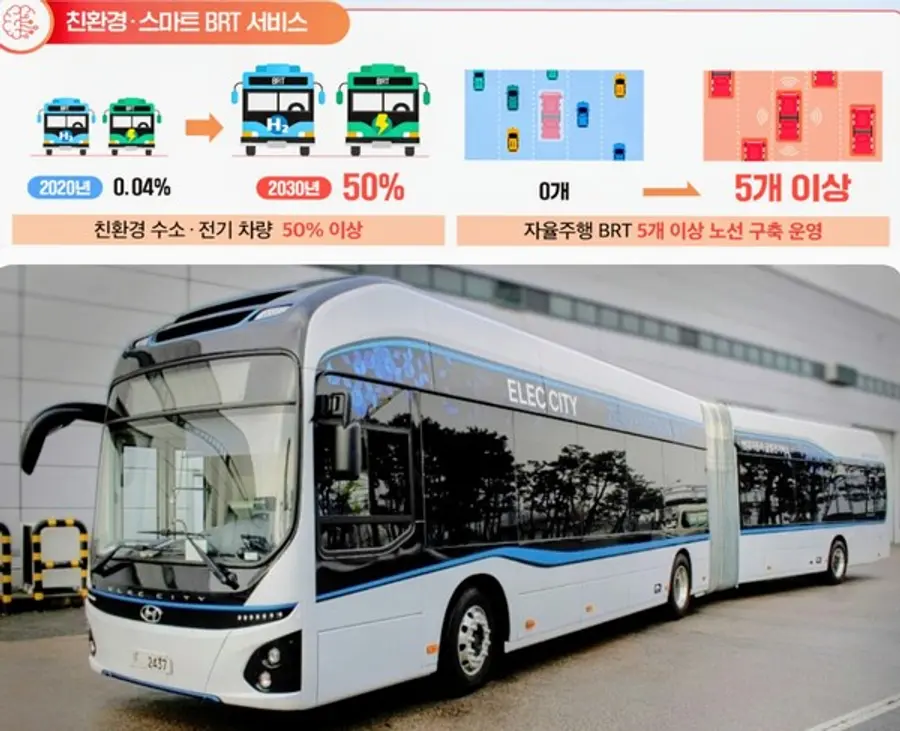
The government plans to increase the proportion of eco-friendly cars such as electricity and hydrogen-fueled from 0.04% in 2020 to 50% in 2030 by promoting the conversion of BRT vehicles.
To this end, the government will increase the input of eco-friendly large-capacity vehicles such as electric refractive buses and establish transfer facilities with hydrogen and electric charging infrastructure at BRT terminal to lay the foundation for eco-friendly vehicle operation.
■ Upgraded BRT services and expanded smart mobility service
S-BRT, a high-end BRT with a regularity and speed of the subway level, will be introduced through exclusive lanes and priority signals.
Among the S-BRT pilot projects (Selected in January 2020 / Gyeyang-Daejang, Incheon, Changwon, Seongnam, Sejong), Changwon S-BRT will be opened by 2023 and Seongnam S-BRT by 2025. A total of 10 billion won will be invested to utilize the results of the S-BRT R&D demonstration project (priority signals, island-style stops, double-door vehicles, etc.) scheduled to be promoted by Sejong City in 2022.
In addition, it plans to lay the foundation for self-driving commercialization services by 2024 by demonstrating self-driving cars, upgrading data, and establishing precise maps in BRT-only lanes so that more than five self-driving BRT routes can be operated by 2030.
Moreover, the government will strengthen BRT accessibility by establishing transfer and charging facilities for personal mobility (PM) transportation such as electric kickboards and bicycles at major BRT stops.
The Ministry of Land, Infrastructure and Transport expects that public transportation services on major arterial roads in the metropolitan area will be dramatically improved, with the BRT route more than tripled and the bus time on major arterial roads shortened by 30% when the revision plan is completed.
“The BRT provides services that are equivalent to urban railways, in speed and timeliness, but the construction cost is only 1/10 of subways and the operating cost is only 1/7, which is a cost-effective transportation,” said Kim Hyo-jung, director of the Metropolitan Transportation Operations Bureau. “We will carry out BRT construction plans and major policy tasks so that BRT can become a preferred public transportation system for more people in the future.”
Meanwhile, 'Comprehensive Plan for the express bus system is a 10-year legal plan established in accordance with the Special Act on the Construction and Operation of the express bus system. The first plan was originally established for 2018-2027, but this revision plan was prepared to reflect changes in traffic conditions in metropolitan areas after the first plan was established, including the creation of the third new city and the promotion of the GTX (wide express railway).
Reported by Smart City Today


![[토큰경제학] 엔비디아의 다음 돈줄은 GPU가 아니라 메모리다](https://cdn.www.smarttoday.co.kr/w400/q75/article-images/2026-06-10/b8779f99-0e61-4370-ab4d-d84e450ee10e.jpg)
댓글 (0)
댓글 작성
댓글을 작성하려면 로그인이 필요합니다.
로그인하기