
[Smart City Today]
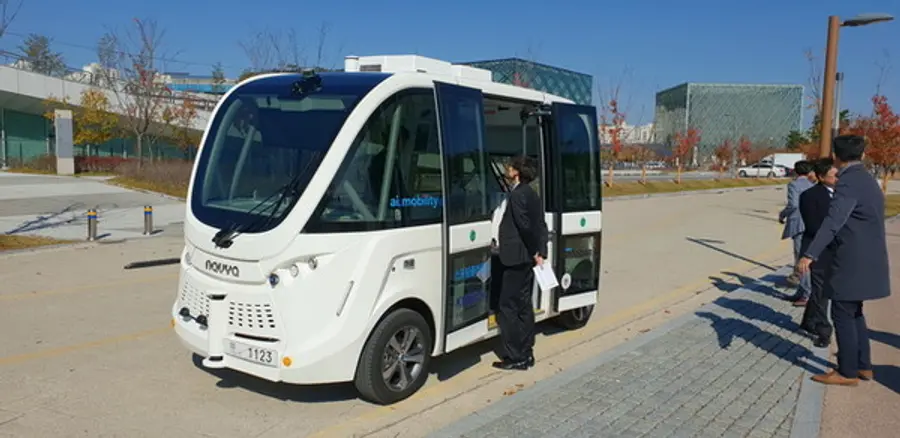
The era of self-driving buses has opened in Korea. Self-driving buses will start operation in Sejong City. Following free trial operations for three months, the government plans to charge a city bus-level fare afterward.
The Ministry of Land, Infrastructure and Transport (Minister Won Hee-ryong), the Metropolitan Transportation Committee (Chairman Lee Sung-hae), Sejong City (Mayor Choi Min-ho), and Chungcheongbuk-do (Governor Kim Young-hwan) announced that they will launch the "BRT-only self-driving Bus" service for the first time in the country.
Self-driving buses will run six round trips on Monday and Friday between 12:00 and 16:00 on the BRT road (Sejong Bus Terminal to Osong Station). It will stop at a total of eight stops, which are on the existing BRT route, Sejong Terminal Ground-Sejong Terminal Underground-Saerom-dong, Naseong-dong-Government Complex South-Government Complex North-Dodam-dong-Hamil-dong-Osong Station. The self-driving buses can be used free of charge by anyone applying in advance through the QR code on the posters of Sejong City and Chungbuk City and BRT stops. After a three-month trial period, the company will switch to a paid service that applies city bus fares.
BRT self-driving buses will be assigned separate route numbers to A2 and A3 and will be in charge of one axis of actual public transportation along with ordinary city buses such as B0, B2, and B4.
The self-driving bus this time is an electric bus (14-seater Apollo 750 and 1 bus) and a general bus (15-seater Lester, 2 buses), and for safe driving, drivers and safety personnel will play a role in safe public services such as getting on and off, guiding self-driving, and responding to emergencies.
The Ministry of Land, Infrastructure and Transport has set a goal of realizing fully autonomous driving (Level 4) buses and shuttles by 2025 through the Mobility Innovation Roadmap (9.19). This BRT self-driving bus service is expected to serve as a meaningful priming water for achieving the goal. When connected to a service app, it is possible to expand to DRT (demand-responsive transportation system, demand-responsive transit) based services, and when combined with PM (personal mobility) services, the realization of MaaS (integrated mobility service, Mobility as a Service) will also be visible.
The introduction of this service was realized through the organic cooperation of related organizations. Last month, the Ministry of Land, Infrastructure and Transport designated Sejong and Chungbuk pilot zones, and the Metropolitan Transport Committee changed related regulations to allow autonomous vehicles to drive in the BRT section. Sejong City and Chungcheongbuk-do Province selected Autonomous A2Z as operators to operate the route (in August) and conducted advice and safety inspections by experts in the autonomous driving field for about three months to implement stable services.
Eo Myeong-so, 2nd Vice Minister of Land, Infrastructure and Transport said, “The BRT self-driving bus service launched this time is the first case in Korea where self-driving buses were introduced on arterial roads. It is planned to expand the service to major areas in the Chungcheong region, such as Cheonan and Asan.”, and “In the future, the government plans to continue to expand the pilot operation district and provide administrative and financial support to local governments so that more general citizens can experience autonomous driving services.”


![[토큰경제학] 엔비디아의 다음 돈줄은 GPU가 아니라 메모리다](https://cdn.www.smarttoday.co.kr/w400/q75/article-images/2026-06-10/b8779f99-0e61-4370-ab4d-d84e450ee10e.jpg)
댓글 (0)
댓글 작성
댓글을 작성하려면 로그인이 필요합니다.
로그인하기